Introduction
Installing a counterfeit or sub-standard spare part in a main propulsion engine is a direct path to catastrophic failure. When a fuel pump plunger seizes because the clearance tolerances were off by a fraction of a millimeter, or a cylinder liner cracks due to inferior metallurgy, the resulting downtime can cost a ship owner tens of thousands of dollars per day. The problem is that modern counterfeit parts often come in packaging that perfectly mimics the Original Equipment Manufacturer (OEM). Relying solely on the label on the box is a high-risk strategy. Identifying genuine marine spare parts requires a systematic physical inspection, metallurgical verification, and strict supply chain auditing before the component ever reaches the engine room.
The Technical Reality of OEM Specifications
Original Equipment Manufacturers engineer parts to withstand extreme thermal stresses, mechanical loads, and corrosive environments. A genuine marine spare part is manufactured using specific alloys, precise heat treatments, and exact dimensional tolerances.
When evaluating a component like a main engine exhaust valve, the stem and seat undergo specialized hardening processes (e.g., stellite coating or Nimonic alloy construction). Counterfeiters typically replicate the dimensions but fail to replicate the material properties or surface treatments. If a non-genuine exhaust valve is installed, the inferior material will rapidly degrade under the high-temperature corrosive gases of heavy fuel oil (HFO) combustion, leading to valve blow-by, loss of compression, and potential turbocharger damage from debris.
Verification Methods and Inspection Procedures
Marine engineers use several methods to verify authenticity upon delivery:
- Dimensional Verification: Engineers use micrometers and vernier calipers to check critical dimensions against the OEM manual. Even a 0.05mm deviation in a piston ring groove clearance can indicate a non-genuine part.
- Material Hardness Testing: Portable hardness testers can verify if a component has undergone the correct heat treatment. A camshaft roller with insufficient surface hardness will pit and fail prematurely.
- Visual and Surface Finish Inspection: OEM parts have specific machining marks and surface roughness (Ra values). Counterfeit parts often look "too shiny" or have inconsistent machining patterns.
- Documentation and Traceability: Genuine parts come with proper Class certificates (Lloyd's Register, DNV, ABS) and factory test reports containing batch numbers that match the stamps on the component itself.
Real-World Observations: The Danger of "Look-Alikes"
During marine spare parts inspections aboard vessels, technical superintendents frequently encounter components that look identical to the naked eye but fail under operational stress.
"During a routine main engine overhaul on a bulk carrier, the engineering team received a batch of fuel injector nozzles from an unverified supplier. The packaging featured identical OEM holograms and part numbers. However, during the initial pressure testing on the test rig, three out of the eight nozzles exhibited severe atomization distortion and dripping. Upon closer inspection under magnification, the nozzle hole drilling angles were visibly misaligned compared to genuine OEM specifications. Had these been installed, the engine would have suffered from poor combustion, excessive carbon buildup, and eventual piston crown burning."
Technical teams frequently encounter situations where procurement departments, aiming to cut costs, source parts from "grey market" suppliers. The operational reality is that the cost savings on the initial purchase are completely wiped out by the subsequent machinery damage and vessel off-hire time.
Common Mistakes in Sourcing and Verification
Procurement Mistakes
- Focusing Solely on Price: Automatically selecting the lowest bidder without verifying the vendor's authorization status with the OEM.
- Ignoring the Supply Chain: Purchasing from third-party traders who cannot provide a transparent chain of custody back to the original manufacturer.
Inspection Mistakes
- Relying Only on Packaging: Assuming a part is genuine because the box has the correct logo and part number sticker.
- Skipping Bench Testing: Failing to test components (like fuel valves or relief valves) on the test rig before installation.
Storage Mistakes
- Removing Protective Coatings: Stripping off the OEM anti-corrosion coatings (like Cosmoline) long before the part is ready for installation, leading to rust.
- Improper Stacking: Storing heavy, precision components (like cylinder liners) improperly, causing micro-deformations.
Installation Mistakes
- Not Checking Clearances: Assuming a new part is perfectly sized and failing to measure clearances (e.g., bearing crush or ring gap) during assembly.
- Ignoring Torque Specs: Failing to use calibrated torque wrenches according to OEM manuals when securing the new components.
Practical Checklist: Verifying Genuine Marine Spare Parts
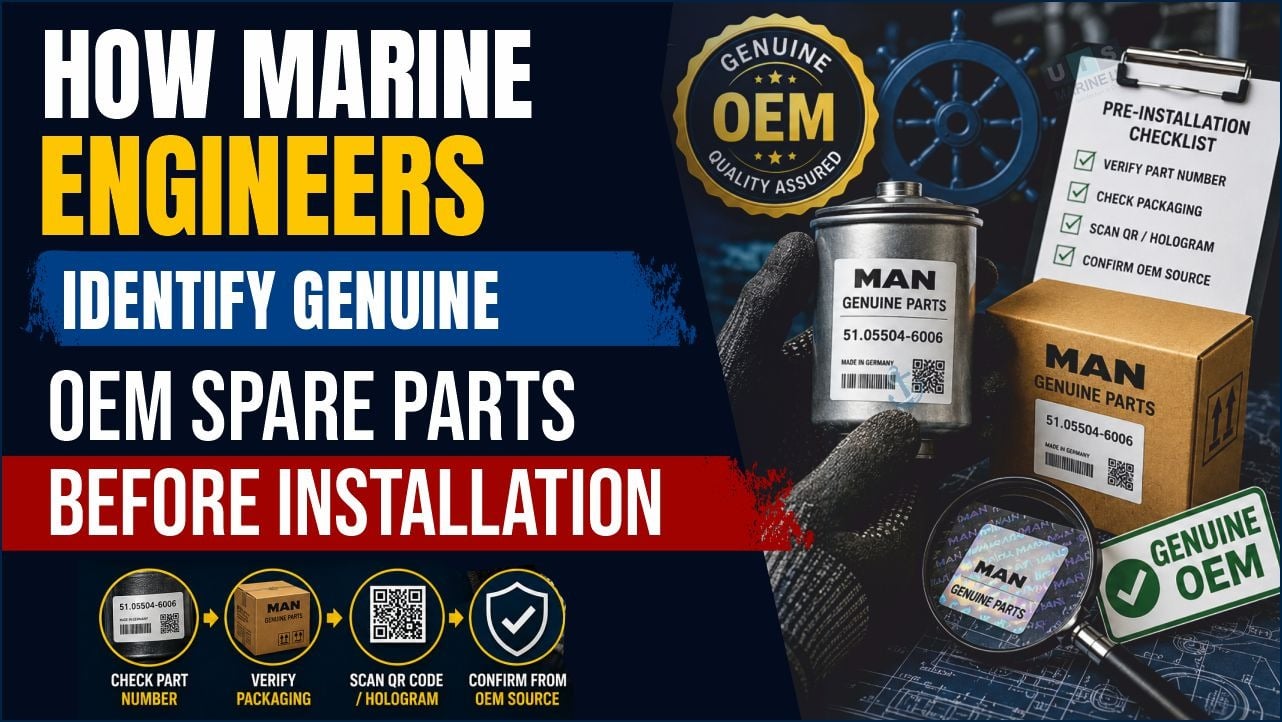
Before a part is accepted and installed, marine engineers should follow this systematic procedure:
- Cross-Check Documentation: Verify the delivery note, certificate of origin, and Class certification against the purchase order.
- Inspect Packaging: Look for unbroken seals, OEM holograms, and correct barcode formats. Check for signs of tampering or generic repackaging.
- Verify Stamping/Engraving: Locate the batch number or serial number stamped directly on the metal component and match it with the paperwork.
- Measure Critical Dimensions: Use precision tools to measure critical tolerances against the engine manual specifications.
- Examine Surface Finish: Inspect for correct machining marks, absence of burrs, and proper surface hardening.
- Check Weight: Genuine parts have a specific mass. Significant weight deviations often indicate inferior alloys or hollow casting defects.
- Perform Pre-Installation Testing: For relevant components (injectors, valves, pumps), perform bench testing or pressure testing before fitting.
Real-World Marine Maintenance Example
On a chemical tanker operating in the Middle East, the auxiliary engine required a routine replacement of the big end bearings. The spares were supplied by a local vendor. The Chief Engineer noted that the protective packaging lacked the usual desiccant packets and the VCI (Volatile Corrosion Inhibitor) paper was generic. Before installation, he measured the bearing shell thickness and found a 0.02mm discrepancy across the shell. Furthermore, the locating lug was slightly off-center. By rejecting these counterfeit bearings and waiting for verified OEM spares, the vessel avoided a high-probability crankcase explosion or crankshaft scoring that would have resulted in months of downtime.
FAQ Section
How can I tell if a marine engine part is counterfeit? Counterfeit parts often have subtle discrepancies in weight, surface finish, and dimensional tolerances. The packaging might look genuine, but the stamping on the metal itself might be laser-etched instead of deep-stamped, or the material hardness will test lower than OEM specifications.
Why are genuine marine spare parts more expensive? Genuine parts are priced higher due to the massive R&D, stringent quality control, superior metallurgical properties, and Class society certifications involved. You are paying for reliability and operational safety, not just the physical metal.
Can non-OEM (aftermarket) parts be used safely? Some highly reputable aftermarket manufacturers produce parts that meet or exceed OEM specs, often referred to as OES (Original Equipment Supplier) parts. However, these must be sourced from proven, Class-approved manufacturers, not anonymous third-party traders.
What is the role of a Class certificate in spare parts? A Class certificate (from DNV, ABS, LR, etc.) proves that the component was manufactured under strict quality control standards and has been independently verified to withstand the stresses of the marine environment.
How does procurement impact machinery failure? Procurement decisions heavily impact reliability. When purchasing departments prioritize the lowest upfront cost over vendor verification, they introduce the risk of sub-standard parts entering the vessel, directly leading to premature component failure and emergency repairs.
Conclusion
Identifying genuine marine spare parts is a critical operational defense mechanism that begins in the procurement department and ends on the engineer's workbench. Relying on packaging is insufficient; actual verification requires dimensional checks, metallurgical understanding, and strict documentation audits. By implementing rigid inspection procedures, ship operators can protect their multimillion-dollar assets from catastrophic failures caused by inferior components.
When sourcing your technical components, partnering with a verified and transparent supplier like UTS Marine LLP ensures that your engineering team receives components that meet the exact tolerances and metallurgical standards required for safe vessel operation.
Internal Linking Suggestions
- [Link: 7 Critical Checks Before Buying Used Marine Engine Spare Parts from Alang Ship Breaking Yard]
- [Link: MAN B&W vs Sulzer Two-Stroke Marine Engines: Spare Parts Comparison for Ship Owners]
- [Link: New vs Reconditioned Marine Engine Parts: How to Choose the Right Option for Your Vessel]