Introduction
Replacing a marine crankshaft is one of the most expensive and time-consuming engine repairs a ship owner can face. Sourcing a used, reconditioned crankshaft from ship recycling yards like Alang offers significant cost savings, but it comes with inherent risks if not properly inspected.
Why Crankshaft Inspection Matters
A crankshaft operates under immense torsional and bending stresses. Prior to purchasing a salvaged unit, engineers must ensure it hasn't suffered from:
- Bearing failures: Which can cause deep scoring and localized heat treatment (hardening) of the journal.
- Lubrication problems: Leading to excessive wear and ovality.
- Fatigue damage: Micro-cracks propagating from the oil holes or fillet radii.
- Misalignment: Causing the crankshaft to bend or warp over time.
Step 1: Visual Inspection
The first line of defense is a thorough visual check under good lighting. We look for:
- Scoring: Deep scratches on the journals that can catch a fingernail.
- Blue marks: Indicating severe overheating and potential metallurgical changes.
- Corrosion: Rust pitting from improper long-term storage without VCI protection.
- Impact damage: Dents on the counterweights or gear teeth from rough handling.
Step 2: Journal Diameter Measurement
Precision measurement is critical to determine if the crankshaft is still within standard dimensions or if it requires grinding to an undersize limit.
- Micrometer checks: We measure the main and crankpin journals at multiple points (top, bottom, and center) across two axes.
- Ovality: The difference between the maximum and minimum diameters on the same plane. High ovality prevents proper hydrodynamic lubrication.
- Taper: The difference in diameter from one end of the journal to the other.
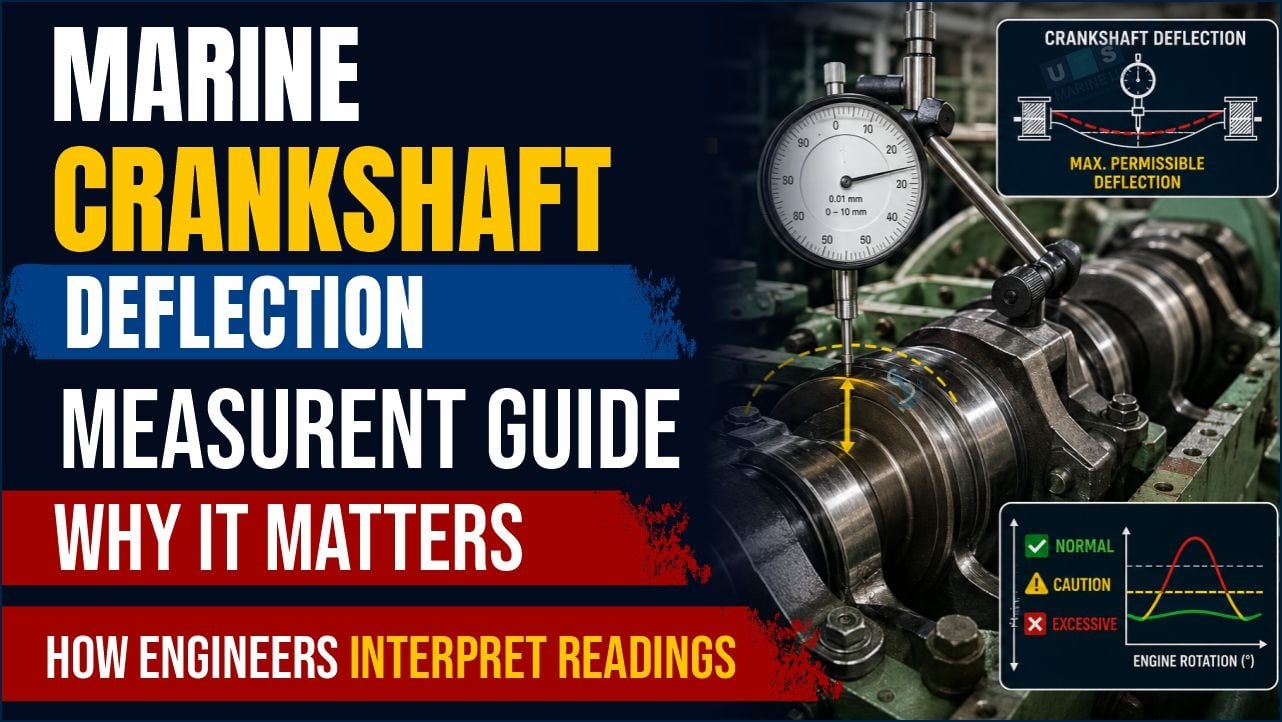
Step 3: Run-Out Measurement
A bent crankshaft will rapidly destroy main bearings.
- Dial gauge procedure: The crankshaft is supported on V-blocks at the outermost main journals, and a dial indicator is placed on the center main journal. The shaft is rotated 360 degrees.
- Allowable limits: Total indicator reading (TIR) must be within strict OEM limits (often less than 0.05mm depending on engine size).
- Alignment concerns: Excessive run-out usually means the crankshaft must be rejected or sent for specialized straightening.
Step 4: MPI Testing (Magnetic Particle Inspection)
Visual inspection cannot detect subsurface fatigue cracks.
- Surface crack detection: MPI uses a magnetic field and iron particles to reveal invisible cracks.
- Journal inspection: Focusing on the oil holes where stress concentration is highest.
- Fillet radius inspection: The transition zone between the journal and the web is a common initiation point for catastrophic fatigue failure.
Common Crankshaft Defects Found in Alang Engines
Defect Primary Cause Journal Scoring Oil contamination (dirt, cat-fines, metal shavings) Fatigue Cracks Cyclic stress, torsional vibration, or operation past overhaul limits Corrosion Pitting Long-term storage without proper preservation (e.g., VCI oil)Procurement Checklist
Always verify these 10 points before finalizing a purchase:
- Exact Engine Maker & Model
- Original Part Number
- Standard or Undersize Dimensions
- Hardness Test Results
- MPI / NDT Certificate
- Run-out / Deflection Report
- Journal Ovality & Taper Report
- Condition of Counterweights & Gears
- Class Society Certification (e.g., DNV, Lloyd's)
- Export Packaging Standards (Wooden Crate, VCI)
Frequently Asked Questions
Can a scored crankshaft be repaired?Yes, if the scoring is not too deep, the journals can be machined down to the first or second undersize limit (e.g., -0.5mm, -1.0mm) as permitted by the OEM, provided matching undersize bearings are used.
What is the difference between UT and MPI testing?MPI (Magnetic Particle Inspection) detects surface and slight sub-surface cracks. UT (Ultrasonic Testing) looks deep into the core of the material to find internal casting flaws.
Why are the fillet radii so critical?The fillet radii transfer the mechanical load between the journal and the web. They are the highest stress concentration areas on a crankshaft, making them the most likely place for a fatigue crack to start.
Do I need a Class Certificate for a used crankshaft?If the engine is the main propulsion unit or a critical auxiliary generator on a classed vessel, the surveyor will almost certainly require the replacement crankshaft to have an IACS class certificate before allowing the vessel to sail.
How is a crankshaft protected during shipping?It must be coated with heavy VCI (Volatile Corrosion Inhibitor) oil, wrapped in VCI plastic, and bolted securely to the base of a heavy-duty, fumigated wooden crate to prevent bending during transit.
How do I measure crankshaft deflection once installed?A specialized deflection dial gauge is inserted between the crank webs. The engine is barred over slowly, and measurements are recorded at 5 specific angular positions to check for web spreading or closing, indicating main bearing misalignment.