Introduction
Of all the catastrophic failures that can befall a marine diesel engine, a main bearing failure is among the most destructive and expensive to recover from. A single wiped bearing, if not caught in time, can score a crankshaft journal so severely that the crankshaft itself must be replaced — a part costing hundreds of thousands of dollars and available only with weeks of lead time from the OEM. Yet the vast majority of marine bearing failures are not sudden events. They are preceded by a clear sequence of warning signs that a vigilant, well-trained engineering team can read and act upon.
This guide details what competent marine engineers look for — in the watch-keeping data, in the lubricating oil analysis, and during physical inspection — to detect a bearing that is deteriorating before it becomes a bearing that has failed.
The Function of Main and Crankpin Bearings
Marine diesel engine bearings serve a single critical purpose: they allow one component to rotate relative to another while supporting enormous loads, by maintaining a continuous hydrodynamic oil film between the bearing surface and the rotating journal. This film — often no thicker than a human hair under full load — is what prevents metal-to-metal contact.
Understanding the type of bearing tells you what failure mode to look for:
- Main bearings: Support the crankshaft in the engine block. They carry the full weight of the crankshaft plus the vertical component of the firing loads from every connecting rod. Their failure directly threatens the crankshaft and the engine block itself.
- Bottom-end (crankpin) bearings: Situated in the big end of the connecting rod, these bearings transmit the enormous peak firing pressure from the piston through the connecting rod to the crankshaft. They experience the highest dynamic loads of any bearing in the engine.
- Top-end (gudgeon pin / small-end) bearings: Connect the connecting rod to the piston. They oscillate rather than rotate and rely on boundary lubrication rather than a full hydrodynamic film.
Early Warning Signs — What to Look for Before Opening the Engine
The most valuable bearing diagnostics happen before a spanner is ever picked up. Engineers with experience recognise these early indicators:
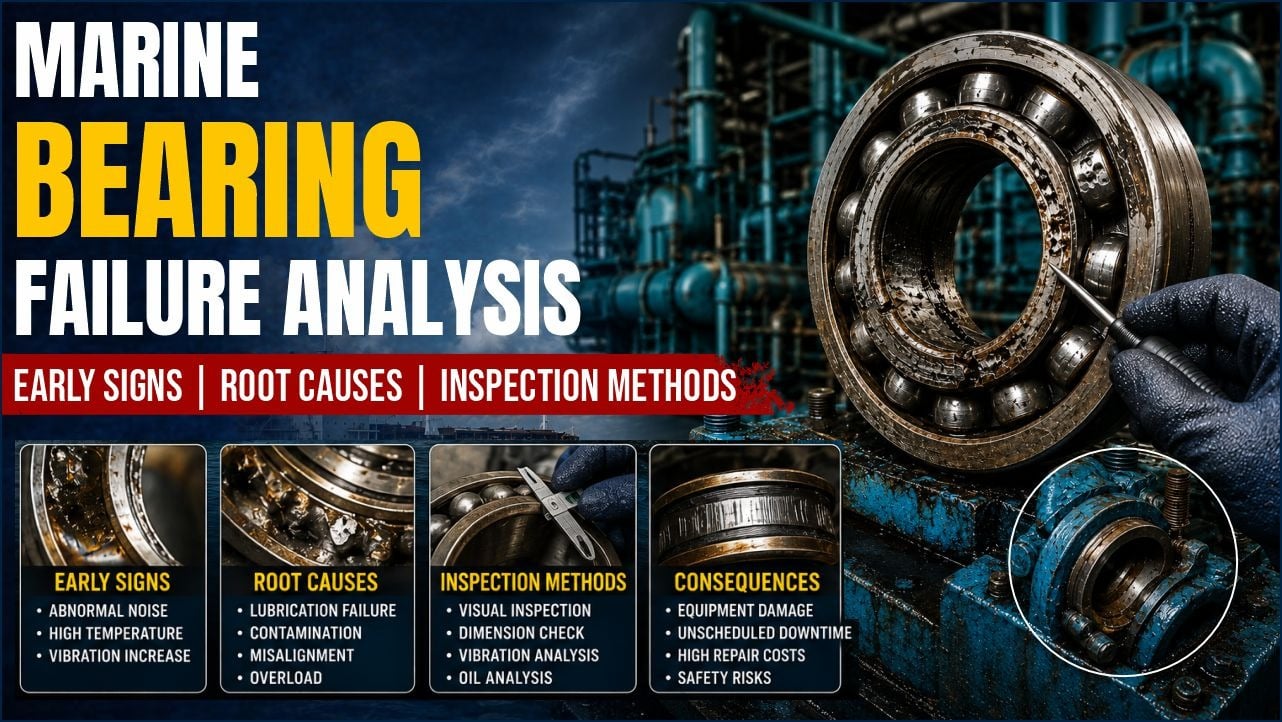
- Increasing main bearing temperature (if fitted with sensors): A bearing temperature that trends upward over weeks — even if it has not yet reached the alarm point — is a bearing that is generating more friction than it should. Treat a rising trend as seriously as an absolute high temperature alarm.
- Lubricating oil sample results: Routine crankcase oil samples sent to a marine oil analysis laboratory reveal the chemistry of what is wearing inside the engine. Rising iron (Fe) and tin (Sn) or lead (Pb) concentrations indicate bearing metal and crankshaft journal wear. A sudden spike in any of these elements after a stable trend is a serious warning — escalate immediately.
- Metallic particles in the lube oil filter: During every scheduled filter service, the old filter element and the magnetic drain plug should be inspected for metallic debris. Bright, shiny silver-coloured particles (white metal) are fragments of the bearing overlay. Dark grey particles are iron from the crankshaft journal or cylinder liner. Neither should be ignored.
- Engine vibration changes: A bearing that has lost its oil film and is operating in boundary or mixed lubrication will create subtle changes in engine vibration signature. Modern ships with online vibration monitoring systems will flag this automatically. On older tonnage, an experienced engineer can sometimes detect a change in engine "feel" during watch rounds.
- Unexplained low lube oil pressure: While low oil pressure can result from a worn pump, stuck relief valve, or a leaking oil cooler, it is also the most critical precursor to bearing starvation. Any unexplained low oil pressure alarm must be investigated as if a bearing is already failing.
Root Cause 1: White Metal Damage
Most marine diesel engine bearings use a tri-metal construction: a steel backing shell, a middle layer of copper-lead alloy, and a thin outer overlay of white metal (an alloy of tin, antimony, and copper — also called Babbitt metal). The white metal overlay is deliberately sacrificial: it is soft enough to conform to minor surface irregularities on the journal and to embed small hard particles harmlessly rather than allowing them to score the harder journal surface.
White metal damage presents in specific, identifiable patterns:
- Fatigue cracking: The white metal layer develops a fine network of cracks ("crocodile skin" or "mud crack" pattern) under repeated dynamic loading. This is a normal end-of-life mechanism for highly loaded bearings and indicates the bearing has reached its service life.
- Wiping: When the oil film collapses completely, the white metal melts and smears across the journal and bearing surface. A wiped bearing has a smooth, almost polished appearance with smeared metal streams. The corresponding journal will have circumferential scratch marks and may show blue heat discolouration.
- Fretting: Micro-movement between the bearing shell and the housing (due to insufficient crush or incorrect fitting) causes fretting corrosion on the back of the bearing shell — a distinctive orange-brown powdery deposit.
- Cavitation erosion: Rapid pressure fluctuations in the oil film (particularly in highly loaded bottom-end bearings during firing) cause micro-bubbles to form and collapse, pitting the white metal surface with a characteristic rough, cratered texture. This is most common in high-speed engines.
Root Cause 2: Oil Starvation
Oil starvation is the most immediate and catastrophic bearing failure mode. When the lubricating oil film is interrupted — even momentarily — the bearing and journal make direct metal contact. The resulting heat is intense enough to melt the white metal overlay within seconds.
The causes of oil starvation are numerous, and experienced engineers check them systematically:
- Lubricating oil pump failure or excessive wear: A pump that can no longer maintain rated pressure at all engine speeds will cause starvation at high load or during manoeuvring.
- Oil filter blockage: A bypassed or completely blocked oil filter deprives the bearing galleries of flow. The differential pressure gauge across the filter provides the primary warning — engineers must check this regularly.
- Air entrainment: Air entering the oil system (from a low sump level, a failed oil pan gasket, or a cracked suction pipe) interrupts the continuous oil film. Air in oil behaves like "no oil" at the bearing surface.
- Oil viscosity breakdown: Oil that has been severely diluted by fuel (from a leaking fuel injector) or thermally degraded loses its viscosity. The reduced viscosity film cannot support the bearing load — metal contact occurs.
- Blocked bearing oil gallery: A partially blocked drillings or cross-passages in the crankshaft itself can starve one specific bearing while all others remain adequately fed. This presents as a single bearing failure with normal oil pressure elsewhere.
Root Cause 3: Misalignment
Crankshaft misalignment causes the main bearing loads to concentrate on one edge of the bearing rather than distributing evenly across the full bearing width. This concentrated edge loading rapidly exceeds the white metal's fatigue limit and produces a very characteristic edge-contact wear pattern.
- Engine block distortion: Long-term thermal cycling, improper mounting, or structural damage to the ship's double bottom can cause the engine bedplate to distort — pulling the main bearing housings out of alignment.
- Incorrect bearing clearances: Bearings fitted with insufficient clearance generate their own heat through reduced hydrodynamic film thickness and will show early fatigue wear. Bearings fitted with excessive clearance allow the journal to move dynamically rather than float stably, causing impact loading on the bearing edges.
- Crankshaft deflection readings: Crankshaft deflection measurement is the primary diagnostic tool for main bearing alignment. An engineer who measures and records deflection readings at every piston overhaul has a continuous record of whether the crankshaft is sitting correctly in its bearings. Any reading outside the builder's limits demands immediate investigation.
Wear Pattern Interpretation — Reading a Bearing Like a Textbook
When a bearing is removed during inspection or overhaul, the pattern of wear across its surface tells the experienced engineer exactly what caused the damage. This is a skill developed through years of hands-on overhaul work:
Observed Wear Pattern Diagnosis Uniform, thin, evenly distributed wear across full bearing width Normal end-of-life wear — replacement due at scheduled overhaul Heavy wear concentrated on one edge of the bearing (top or bottom half) Crankshaft misalignment — check deflection readings; inspect bedplate Heavy wear on the loaded half only (bottom half of main bearing) Overloading or insufficient bearing clearance — verify clearances Fatigue cracks (mud crack pattern) across the full surface End-of-life fatigue — bearing has exceeded its design life Embedded abrasive particles visible in white metal surface Oil contamination — check filter condition and oil cleanliness Wiped surface (shiny, smeared metal) with overheating discolouration Oil starvation event — investigate oil supply chain immediately Cratered, rough surface (cavitation erosion pattern) High dynamic loading — consider engine derating or larger bearing areaBearing Inspection Checklist
- ☑ Record crankshaft deflection readings before any bearing removal
- ☑ Label each bearing shell with its position (main bearing number, top/bottom half) before removal
- ☑ Photograph wear pattern on both top and bottom shells before cleaning
- ☑ Measure bearing clearance with a feeler gauge or plastigauge and record
- ☑ Measure journal diameter with a micrometer — record ovality and taper at all positions
- ☑ Inspect bearing crush by measuring shell protrusion before assembly
- ☑ Inspect oil holes and galleries in the journal and housing for blockage
- ☑ Check the back of the bearing shell for fretting marks
- ☑ Inspect oil feed pipe and non-return valves serving the bearing
- ☑ Renew all bearing shells — never refit shells that show any wear through to the copper layer
- ☑ Apply correct torque to bearing cap bolts in sequence as per engine manual
- ☑ Take new deflection readings after reassembly and compare with pre-overhaul baseline
- ☑ Send an oil sample to the laboratory immediately after returning the engine to service
Frequently Asked Questions
What is the typical bearing clearance for a marine diesel main bearing?Bearing clearance varies significantly with journal diameter and engine speed. As a general guide, medium-speed four-stroke engines typically require clearances between 0.08–0.20 mm on the main journals, while slow-speed two-stroke engines with larger journal diameters may have specified clearances of 0.30–0.50 mm. Always use the engine builder's specific clearance table — using generic values on a marine engine is an invitation to an early failure.
How often should lube oil samples be taken from a marine diesel?The minimum recommended frequency is at every oil charge renewal interval — but most P&I Clubs and technical managers recommend quarterly sampling at minimum, regardless of when the oil was last changed. If a bearing issue is suspected, take a sample immediately, send it via courier (not shipment bulk), and request a priority analysis. A 72-hour turnaround on a bearing metals report can be the difference between an early repair and a catastrophic crankshaft.
Can a scored crankshaft journal be used with new bearings?Absolutely not without remediation. A scored journal will immediately abrade the soft white metal of any new bearing fitted against it — essentially, it will destroy a new set of bearings in a fraction of their normal service life. The journal must first be repaired: ground to the next undersize limit and matched with the corresponding undersize bearing shells, or hard-chromed and reground to standard size if permitted by the OEM. Never fit new bearings against a damaged journal.
What is the difference between trimetal and bimetal bearings?Trimetal bearings have three layers: steel backing, copper-lead or aluminium alloy intermediate layer, and a thin lead-tin or tin-bismuth white metal overlay. The overlay is the running surface. Bimetal bearings have only two layers — steel backing and an aluminium alloy bearing surface — with no overlay. Bimetal bearings are harder, more fatigue-resistant, and used in high-speed, high-load applications. They are less forgiving of misalignment and contamination than trimetal bearings but last longer under ideal conditions.
What crankshaft deflection reading should trigger an immediate engine stop?Any single deflection reading that falls outside the builder's permissible limits — which are typically specified as a maximum value in millimetres, often 0.02–0.05 mm depending on engine size — should be taken seriously. A sudden change in deflection readings between two consecutive measurement sessions is more alarming than an absolute value because it indicates something has changed: a bearing has shifted, collapsed, or been wiped. Do not restart the engine until the cause of the changed deflection is identified.