Introduction
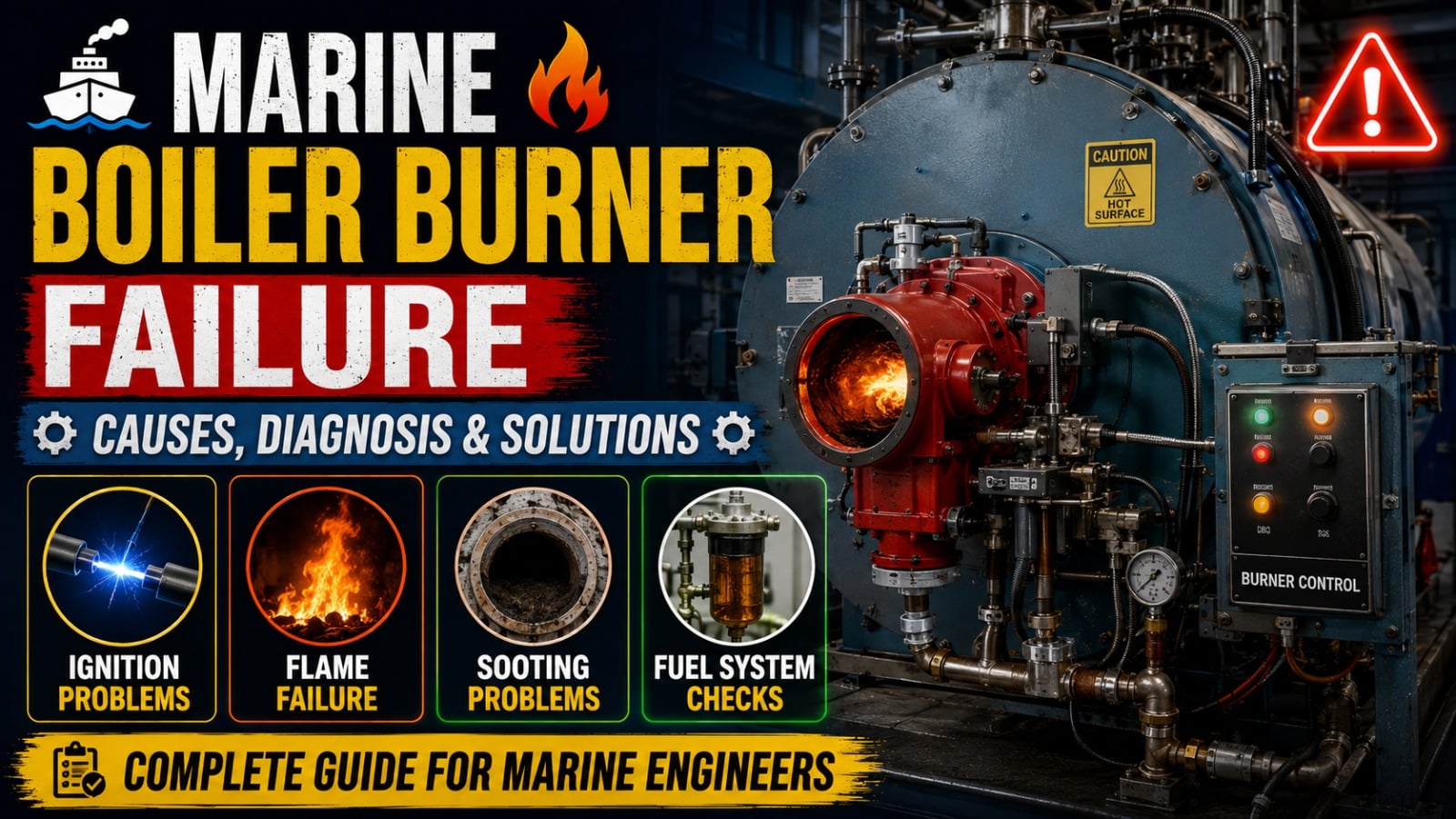
When the auxiliary boiler burner starts misbehaving, the effects spread through the ship faster than almost any other machinery fault. No steam means no fuel heating for the main engine, no tank heating, no heating for accommodation, and on tankers a direct threat to cargo operations. A burner that trips in and out every ten minutes does not just annoy the engine room — it short-cycles the boiler, coats the tubes in soot, and eventually puts the plant off the line at the worst possible moment.
Burner faults come down to a handful of fundamentals: fuel arriving at the nozzle in the right condition, air in the right proportion, a spark strong enough to light the mixture, and a flame detector that sees what is actually happening. When any one of them slips, the burner either refuses to light, lights and dies, or lights and soots. This article takes each symptom in turn and connects it to the checks that find the real cause.
How a Marine Boiler Burner Works
Auxiliary boiler burners on merchant ships — Saacke, Weishaupt, Oilon, Hamworthy rotary cup units, and steam-atomising guns on larger plants — all run the same sequence:
- Fuel supply: A fuel unit or pump raises oil pressure to the burner. Heavy fuel arrives heated to the viscosity the maker specifies; marine diesel oil plants run simpler arrangements. Filters and a pressure gauge before the burner tell the fuel story.
- Atomization: A pressure jet swirls oil through fine slots and out an orifice as a cone of droplets; a rotary cup flings oil off a spinning rim into an air stream; steam-atomising guns use steam at a set differential to shear the oil into mist. Droplet size decides everything that follows.
- Ignition: An ignition transformer drives a spark across two electrodes set to a precise gap and position in the spray cone. The spark must land inside the fuel mist, not beside it.
- Flame monitoring: A flame detector — a photocell, a UV scanner, or a rectification rod on gas burners — proves the flame within a few seconds of the fuel valve opening, and keeps proving it throughout firing. Lose the proof signal and the burner trips to lockout.
- Air supply: The forced draught fan delivers combustion air through the register, where swirl vanes mix it with the oil spray. Damper position at low fire and high fire sets the air/fuel ratio; the burner quarl (refractory throat) shapes the flame.
Every fault in this article is one of these five links failing — sometimes one, sometimes two at once, which is what makes burner diagnosis interesting.
Burner Fails to Ignite
The sequence runs, the fuel valve opens, and then the flame safeguard drops the burner into lockout. Before anything else, read the actual lockout indication on the programmer — it counts attempts and often names the stage. Then check in this order:
Ignition Transformer and Electrodes
Weak transformers, cracked electrode insulators, and electrodes set to the wrong gap fail more often than any fuel component. The gap is small — a couple of millimetres on most units — and the electrode tips must sit in the fuel spray. Pull the gun, check the gap with a feeler gauge, look for tracking marks on the porcelain, and listen for the spark character when the boiler is safe to attempt ignition. A fat, blue, snapping spark ignites oil; a thin, lazy violet arc does not.
Fuel Not Arriving
Choked filters after a bad fuel delivery, a stuck solenoid valve, or a fuel unit losing prime all stop the spray regardless of what the spark does. Verify pressure at the burner with a gauge during the trial-for-ignition window. Zero or low pressure sends you upstream: filters, solenoid, pump coupling, or an air-locked line after tank changes.
Poor Atomization
Oil arriving as a stream instead of a mist will not light, or lights as a lazy orange tongue that the flame eye rejects. On pressure-jet burners, the usual culprits are an oil temperature too low for the fuel being burned (viscosity off spec), a worn or partially choked jet, or carbon building at the tip. On steam-atomising guns, check the atomising steam pressure differential and confirm the steam is dry — wet steam is a classic after a priming event in the boiler.
Too Much Air at Ignition
A damper that opens too far at low fire blows the fragile ignition flame away before it stabilises. If the burner lights briefly and dies within a second or two, the air register position at low fire is suspect — especially after anyone has adjusted the linkage or replaced the servo motor.
Flame Failure During Operation
Burner lights, runs, and then trips — sometimes minutes later, sometimes at the worst frequency: the changeover between low fire and high fire. The causes split into three groups:
- Detector problems: A sooted photocell lens or a tired UV scanner slowly loses the ability to prove flame. Clean the lens and sight tube first — it costs nothing and fixes a surprising share of nuisance trips. Photocells weaken with age; if the cell has years on it, renew it on suspicion and keep a spare in the spares locker.
- Fuel instability: Water or sludge arriving from the service tank in pulses, a pump producing pressure ripples, or a filter clogging progressively all destabilise the spray. Pressure gauge flutter during firing is the evidence. Settle the fuel supply — settle, not just filter.
- Air/fuel ratio drifting: Loose linkage arms, a worn servo, or an air damper that has slipped change the ratio between the conditions the burner was commissioned at. Trips at load changeover are the signature. Re-commission the ratio at low fire, high fire, and the intermediate positions against flue gas readings.
One more cause that hides in plain sight: flame instability at low load from a burner designed to run hotter than it is. If the plant spends all day at minimum fire because steam demand is small, the spray cools, the cone gets lazy, and the flame wanders. Some burners simply need to be off in those conditions rather than limping.
Excessive Soot Formation
Soot is unburned carbon, and it means atomization, air, or both went wrong at the same time. Heavy soot loads are also a safety matter — a soot fire in a boiler is not a hypothetical. The contributors, roughly in order of how often they are guilty:
- Atomization gone poor: oil temperature low, jet worn or choked, atomising steam differential wrong. The flame tells you: a sooty burner flame is longer, lazier, and darker at the edges than the tight, bright flame you logged at commissioning.
- Not enough air: damper not reaching its position, swirl vanes carboned so the swirl pattern has collapsed, fan suction restricted. Check what the damper actually does against the indicator; a linkage pin that has fallen out turns a 30% air loss into an invisible one.
- Fuel quality: high asphaltene cargoes and poor settling behaviour produce soot even at correct settings. Treat, settle, and rotate tanks; adjust excess air slightly upward for the worst fuels.
- Short cycling: a boiler that starts and stops every few minutes soots at every cold start because combustion never stabilises. Fix the reason for cycling — usually a leaking steam trap, a faulty steam pressure switch, or oversized burner — instead of cleaning the soot and waiting for it to return.
- Dripping after shutdown: oil pooling in a hot firebox carbonises and sits there for the next start. A dripping nozzle or a weeping fuel valve needs attention the day you see it.
Poor Combustion
Between "lights and runs" and "makes black smoke" lies the long middle ground of combustion that works but wastes. The measurements that matter: excess oxygen in the flue gas (for HFO firing, most burners should sit around 2–4% O2 when set correctly), flue gas temperature (a sudden rise with soot points to fouled heating surfaces; a low flue temperature with heavy soot at low load is its own warning), and the smoke spot number if the ship carries the kit.
Flame appearance is still legitimate diagnostic data. A stable HFO flame is bright orange-yellow with a defined shape leaving the quarl. Flame impingement on tubes or refractory — long, searching tongues of flame — over-heats the metal it touches and wrecks refractory in weeks. Impingement usually traces back to wrong atomization pressure, collapsed swirl, or a damaged quarl changing the flame shape.
Fuel Nozzle Inspection
The pressure jet is a precision part worn out by design. Every strip-down should check:
- The orifice: erosion widens it, and a widened orifice changes the flow and spray angle at a given pressure. Compare against a new jet — "a bit bigger" is enough to matter.
- Swirl slots: choked slots flatten the spray; worn slots change the angle. Look for score lines and partial blockage under magnification.
- The internal filter and strainer in the gun assembly, and the condition of the tip seat faces — a damaged seat leaks internally and drips after shutdown.
- Carbon at the tip: distinguishes "dripping burner" from "hot firebox sooting the tip". Different fixes.
Practical advice from the workshop: jets are not rebuild items. Renew them, keep the old ones for pattern reference, and log the running hours. When a burner's combustion quality drifts over months, the jet hours are usually the first line of the answer. Rotary cup units have their own wear list — cup rim condition, primary air fan, and the distribution spindle — and the same principle holds: geometry wears, spray quality follows.
Burner Air Register Inspection
The air register and quarl shape the flame, and they live in the dirtiest, hottest spot on the boiler:
- Swirl vanes: carbon build-up between the vanes changes the whole mixing pattern. Clean and inspect for burned or missing vane sections.
- Damper and linkage: full travel at low and high fire, no slop in the joints, position indicator matching reality. Re-commission after any work.
- Quarl condition: cracked, spalled, or displaced refractory alters flame shape and lets air short-circuit past the flame. Small cracks get worse fast at HFO temperatures; repair or renew per the maker's refractory spec.
- Ignition electrode position relative to the register — after any register work, the electrode geometry changes with it.
Flame Scanner and Sensor Checks
The flame safeguard is the part that stops a boiler becoming an explosion case study, so its detector deserves more than a wipe:
- Clean the lens and sight tube on the scheduled interval — weekly in heavy-fuel service is not excessive. A sooted lens makes the burner trip on flame failure while the flame is still burning; a badly sooted one can, more dangerously, mask marginal ignition.
- Check the sighting angle. The detector must look at the flame root where ultraviolet output and flicker are strongest, not at the far end of a long flame that may shorten at low fire.
- Test the response. The safeguard must trip the burner within its specified time when the flame disappears — a few seconds at most. Perform the failure test per the maker's procedure during every planned shutdown, and log the result. A detector that "usually works" is not a detector; it is a liability with a lens.
- Cooling arrangements: where the scanner has cooling air or a purging arrangement, prove it is flowing. Heat-killed scanners fail in the direction of nuisance trips — until the day they fail the other way.
Burner Troubleshooting Table
Symptom Likely Cause Recommended Check Burner locks out at ignition attempt Weak spark; no fuel at nozzle Electrode gap and insulators; fuel pressure at burner during trial Ignites, dies within seconds Excess air at low fire blowing the flame off Damper position at low fire; register linkage; re-commission ratio Nuisance flame failure trips while running Sooted detector lens; tired photocell; sighting tube dirty Clean lens and tube; test response time; renew ageing cells Trips specifically at low/high fire changeover Air/fuel ratio drifted; linkage or servo wear Flue gas readings at each position; linkage tightness; servo stroke Heavy soot accumulating on tubes Poor atomization or insufficient air Oil temperature and viscosity; jet condition; damper travel and vanes Burner short-cycles every few minutes Faulty pressure switch; leaking steam trap; oversized firing rate Switch settings; condensate load; minimum fire stability Oil pooling/dripping after shutdown Leaking fuel valve or damaged nozzle seat Valve tightness test; jet seat inspection; renew as required Flame impinges on tubes or refractory Wrong atomizing pressure; collapsed swirl; damaged quarl Atomizing differential; swirl vane condition; refractory surveyMaintenance Checklist
Daily
- Log fuel pressure and temperature at the burner, steam pressure, flue gas temperature, and flame appearance.
- Note every lockout and how it cleared. Patterns matter more than single events.
- Blow through and check the boiler water side as scheduled — burner health and water condition are not separate worlds.
Weekly
- Clean the flame detector lens and sight tube; check cooling air flow where fitted.
- Check burner front for oil weeps, carbon trails, and dripping.
- Review filter differential pressures across the fuel line.
Monthly
- Inspect electrodes: gap, position, insulator condition.
- Check damper linkage and position indicators through full travel.
- Flue gas analysis at low, mid, and high fire; record O2 and stack temperature trend.
3–6 Monthly / Opportunity
- Withdraw the gun: inspect and renew the nozzle/jet, clean the register and swirl vanes, survey the quarl refractory.
- Function-test the flame safeguard failure response and the full purge timing.
- Calibrate fuel pressure gauges and verify the fuel unit output against spec.
Genuine and reconditioned burner components — pressure jets, electrodes, transformers, flame detectors, servo motors, and complete burner spares for Saacke, Weishaupt, Oilon, and Hamworthy units — are regular stock items for us. See our marine boilers and burners page or send your requirement with the burner make and type.
Frequently Asked Questions
Why does my burner trip on flame failure even though the flame is visibly burning?
The detector cannot see it. A sooted lens, a dirty sight tube, a weakened photocell, or a sighting angle that misses the flame root all starve the safeguard of proof signal. Clean and test the detector before touching fuel settings — and remember the failure response test, because a detector failing in the unsafe direction is the dangerous version of this fault.
What temperature should heavy fuel oil be at the burner?
Heat to the viscosity the burner maker specifies, not to a memorised number — for most pressure-jet burners on HFO that lands somewhere around 110–125°C depending on the fuel's viscosity-temperature curve. If you have changed fuel grade, the temperature follows the fuel. Running cold oil is the fastest route to poor atomization and soot.
How do I tell a worn pressure jet from a fuel supply problem?
Pressure at the burner during firing and flame geometry. Low, fluttering pressure with a lazy flame says supply — filters, pump, or line. Correct pressure with a deteriorating flame shape over weeks of running says jet wear. Log jet hours; the correlation is usually clean.
Why does the burner soot more in port than at sea?
Port operation means low, intermittent steam demand, so the burner short-cycles and idles at minimum fire where atomization and temperatures are least favourable. Reduce cycling by fixing steam leaks and pressure switch behaviour, keep the fuel hot and filtered, and expect to inspect the register and jet more often on ships with light steam loads.
What is the correct electrode gap for ignition?
Follow the burner maker's figure — typically a couple of millimetres — and treat position as part of the setting: the spark must reach into the fuel spray cone. After any gun or register work, reset the electrodes to the manual's geometry rather than by eye from memory.
Can I fire the boiler with the flame safeguard bypassed to get steam urgently?
No. The flame safeguard is the device standing between a controlled burner and a fuel-filled firebox. Bypassing it after repeated trips has caused boiler explosions with fatalities. Find the trip cause — detector, fuel, or air — with the plant cold, or accept the loss of steam until it is fixed.
How often should the flame scanner be renewed rather than cleaned?
Photocells and UV tubes degrade with hours and heat even when kept clean. Renew at the maker's recommended interval or when response time testing shows slowing — and always keep a spare on board. A scanner is cheap; the steam outage while waiting for one is not.