Introduction
The cylinder liner is the heart of the combustion chamber. Monitoring its wear rate is one of the most critical maintenance tasks for any marine engineer. A healthy liner ensures proper compression, minimal lube oil consumption, and prevents catastrophic piston blow-by.
Types of Cylinder Liner Wear
Liner wear is rarely uniform. It manifests in three distinct ways:
- Abrasive wear: Caused by hard particles (like cat-fines or dirt) trapped between the piston rings and the liner wall. It acts like sandpaper, rapidly grinding away the metal.
- Adhesive wear (Micro-seizure): Occurs when the lubricating oil film breaks down, causing metal-to-metal contact between the rings and liner. Micro-welds form and tear apart as the piston moves.
- Corrosive wear: Caused by sulfuric acid formed during the combustion of high-sulfur heavy fuel oil. If the cylinder liner temperature is too low (below the dew point), acid condenses on the walls and eats away the iron.
What is Scuffing?
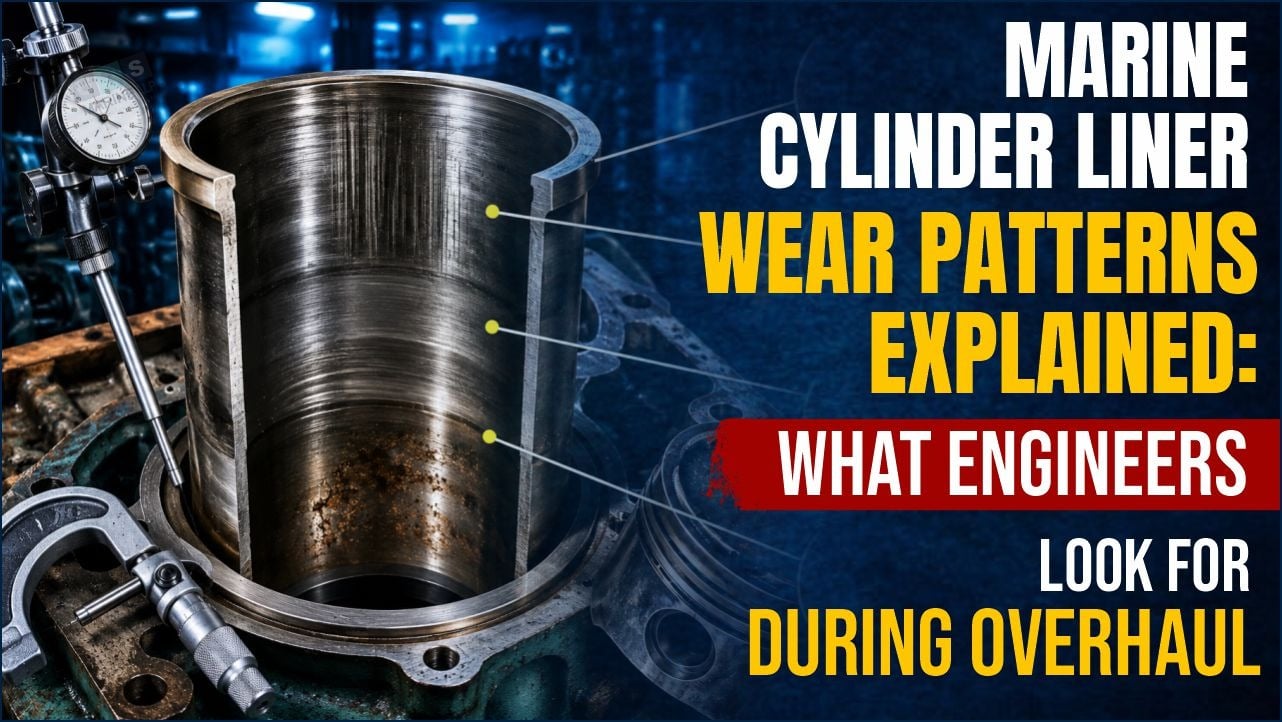
Scuffing is a severe form of adhesive wear. It presents as vertical scratch marks or widespread polished patches where the original honing cross-hatch pattern has been completely destroyed. Once a liner scuffs, the piston rings cannot seal, blow-by increases, and the localized heat can cause a crankcase explosion.
Measuring Cylinder Liner Wear
Liner wear is measured accurately during a piston overhaul:
- Tools used: An inside micrometer or a specialized cylinder bore gauge set.
- Procedure: Measurements are taken at multiple vertical positions (e.g., TDC, mid-stroke, BDC) and across two axes (Fore-Aft and Port-Starboard).
- Clover-leafing: Engineers look for uneven wear patterns, such as "clover-leafing," which indicates issues with cylinder lubricator quill performance.
Wear Limits and Replacement Decisions
Condition Action Normal Wear (< 0.1mm/1000 hrs) Continue service. Monitor closely. Glazed Surface (Polishing) Hone the liner in-situ to restore the cross-hatch pattern for oil retention. Max Wear Limit Exceeded (e.g. 0.6% to 0.8% of bore diameter) Replace the cylinder liner immediately.Frequently Asked Questions
Why do we hone a cylinder liner?Honing creates a microscopic cross-hatch groove pattern on the liner surface. These tiny grooves hold cylinder lubricating oil, ensuring the piston rings ride on a fluid film rather than dry metal.
How does cylinder cooling water temperature affect wear?If the jacket cooling water temperature is too low, sulfuric acid condenses on the liner walls, causing severe corrosive wear. If it is too high, the lubricating oil film burns off, leading to scuffing and adhesive wear.