Introduction
The camshaft dictates the entire breathing and fueling cycle of a marine diesel engine. Even minor wear on the cam lobes or incorrect timing adjustments drastically alter engine performance, leading to high exhaust temperatures, poor combustion, and increased fuel consumption. Routine inspection during overhauls is mandatory to prevent these operational inefficiencies.
Camshaft Function and Construction
Driven by the crankshaft via a gear train or chain drive, the camshaft actuates the fuel injection pumps, exhaust valves, and intake valves (in 4-stroke engines). Marine camshafts are typically constructed from high-tensile forged steel. The lobes and bearing journals undergo case hardening (like induction or flame hardening) to withstand the extreme localized pressures exerted by the follower rollers.
Common Wear Patterns
Because camshafts operate under high point-loading, they are susceptible to specific types of wear.
Lobe Wear
The cam lobe consists of a base circle, flanks, and a nose. Wear typically occurs on the flanks and the nose where acceleration and lifting forces are highest. Look for:
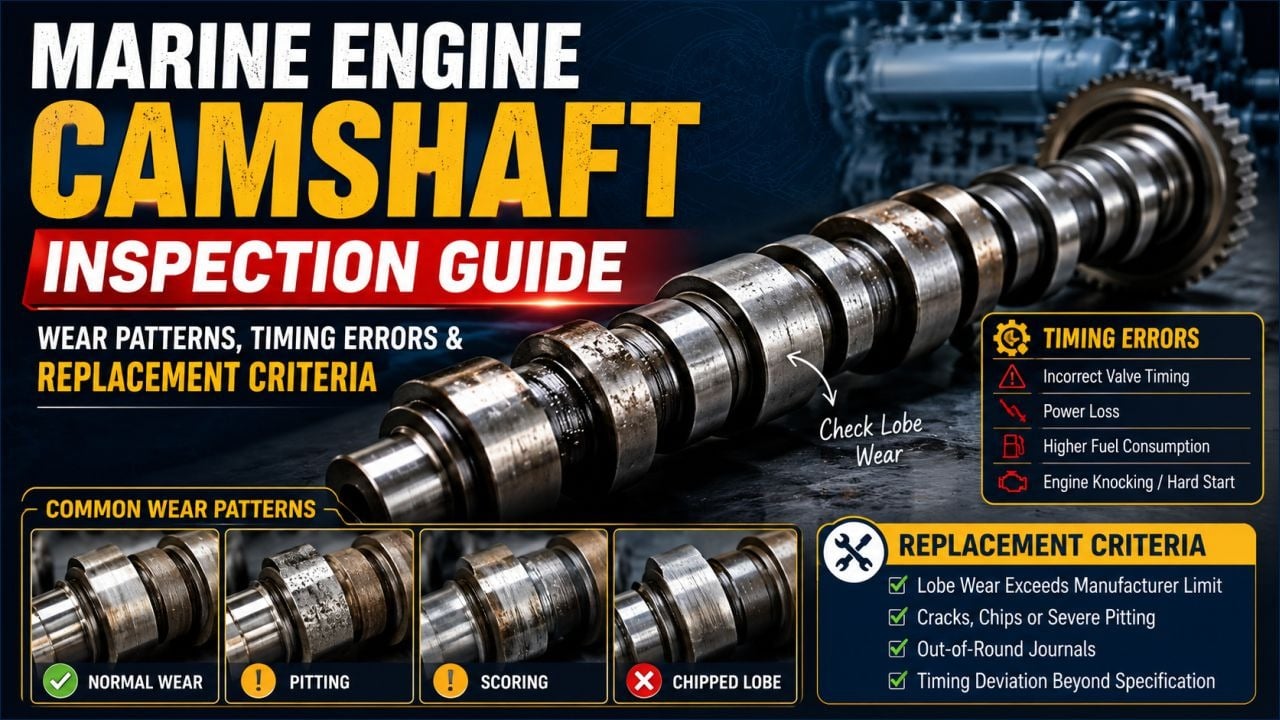
- Pitting and Spalling: Fatigue failure of the case-hardened surface, causing flakes of metal to break away. This is often caused by excessive tappet clearance causing hammering, or poor lubrication.
- Scoring: Deep scratches parallel to the rotation, indicating particulate contamination in the lubricating oil.
- Flattening of the Nose: Reduces the maximum valve lift or fuel pump stroke, severely impacting volumetric efficiency and fuel delivery volume.
Journal Wear
Camshaft journals run in split shell bearings or solid bushings. Wear here increases the running clearance, which can cause the camshaft to vibrate or bend under load, altering the valve timing dynamically. Measure journals for ovality and taper using an outside micrometer.
Timing Errors and Symptoms
Camshaft timing can shift due to gear train wear, chain elongation, or slipped shrink-fit cam lobes (on built-up camshafts).
- Retarded Fuel Timing: Results in late combustion, high exhaust gas temperatures (EGT), and heavy black smoke.
- Advanced Fuel Timing: Causes knocking, excessive peak firing pressures (Pmax), and mechanical stress on the cylinder head and bearings.
- Incorrect Valve Timing: Leads to poor scavenging, low compression, and the risk of the piston striking the exhaust valve.
Inspection Procedure
A rigorous inspection goes beyond a visual check.
- Visual Check: Clean the lobes thoroughly. Use a strong flashlight to check the flanks for micro-pitting, bluing (overheating), or uneven wear tracks from the follower roller.
- Profile Measurement: Use a template gauge or a dial indicator mounted on the cylinder block to measure the base circle radius and the maximum lift at the nose. Compare these readings against the OEM shop manual.
- Roller Follower Inspection: Never inspect a camshaft without checking the corresponding follower rollers. A seized roller pin will quickly grind a flat spot onto the cam lobe.
- Clearance Checks: Measure the camshaft bearing clearances using Plastigauge or by taking internal micrometer readings of the bearing shells and subtracting the journal diameter.
Replacement Criteria
A camshaft or individual cam segment (if sectional) must be replaced if:
- The case-hardened layer is worn through or heavily spalled.
- Maximum lift is reduced beyond the OEM tolerance (usually specified in tenths of a millimeter).
- Journal ovality exceeds the maximum allowable limit, preventing proper bearing seating.
- There is evidence of cracks around the drive gear keyway or flange bolts.
Checklist for Overhaul
- ✓ Record dial gauge lift measurements for every lobe.
- ✓ Inspect drive gear backlash and gear tooth condition.
- ✓ Verify tappet clearances are set exactly to cold/hot specifications.
- ✓ Confirm lubricating oil spray nozzles directed at the cams are clear of blockages.
Frequently Asked Questions
Can a worn cam lobe be built up and re-machined?While possible in automotive applications, marine engine camshafts endure too much stress for weld-buildup repairs to be reliable. Worn segments or the entire shaft must generally be replaced.
How does chain elongation affect timing?In chain-driven camshafts, as the chain stretches over thousands of hours, the camshaft rotation slightly lags behind the crankshaft, retarding both valve and fuel timing. This requires adjustment of the chain tensioner or advancing the cam gear.
Why do built-up camshafts sometimes slip?Built-up camshafts use individual lobes shrunk-fit onto a plain shaft. If the engine suffers a severe hydraulic lock or fuel pump seizure, the rotational force can overcome the friction fit, causing the lobe to slip and instantly altering timing for that specific cylinder.