Introduction
Flexible couplings are the unsung heroes of marine propulsion and power generation. Positioned between the engine and the gearbox, or the engine and the alternator, they transmit immense torque while isolating destructive torsional vibrations. Failing to inspect and maintain these couplings leads to sheared bolts, damaged gearboxes, and catastrophic bearing failures.
What Flexible Couplings Do
A marine diesel engine does not produce smooth, continuous rotational force; it produces firing pulses. The flexible coupling absorbs these shock loads. It also accommodates minor unavoidable parallel, angular, and axial misalignments that occur as the ship's hull flexes in a seaway or as engine mounts compress over time.
Types of Marine Couplings
The most common types encountered by marine engineers include:
- Highly Flexible Rubber Couplings: Use rubber blocks or ring elements in shear or compression (e.g., Vulkan, Centa). Excellent for damping torsional vibration.
- Steel Spring Couplings: Use packs of leaf springs (e.g., Geislinger). Highly durable and unaffected by oil or heat, primarily damping through hydrodynamic oil displacement.
- Gear Couplings: Accommodate high axial movement and torque but offer minimal torsional damping. Require continuous lubrication.
Misalignment Symptoms
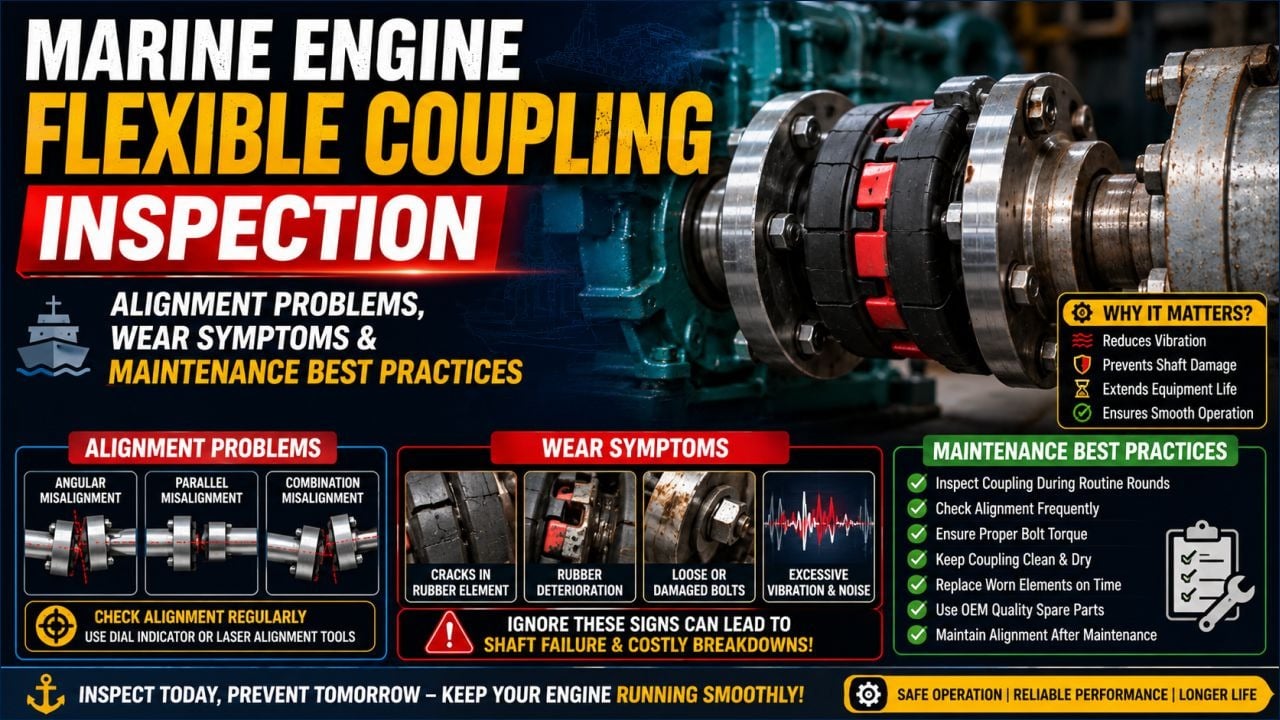
Couplings are designed to handle some misalignment, but exceeding limits accelerates wear rapidly. Symptoms include:
- Excessive Vibration: A sudden change in the vibration signature of the driveline, felt through the deck plates or detected by vibration monitoring equipment.
- Abnormal Noise: Clunking or heavy knocking at low RPMs or during clutch engagement.
- High Bearing Temperatures: Misalignment forces are transferred directly to the engine's thrust bearing or the gearbox input shaft bearing, causing localized overheating.
Rubber Element Deterioration
For rubber element couplings, aging is the primary enemy. Heat, ozone, and oil contamination cause the rubber to harden, crack, and lose its elasticity (Shore hardness changes). Once the rubber hardens, it stops damping torsional vibration, transferring those destructive forces directly into the engine crankshaft.
Inspection and Alignment Checks
Regular inspection is critical. Do not wait for a failure.
- Visual Inspection: Look for black rubber dust around the coupling guard, which indicates the elements are tearing or chafing. Check for oil leaks that could degrade the rubber.
- Shore Hardness Test: Use a durometer to measure the hardness of the rubber elements. Compare the readings against the manufacturer's rejection limits.
- Axial Float Measurement: Verify the coupling can move axially within its designed limits to prevent thrust loading on the engine bearings.
- Laser Alignment: Dial indicators or laser alignment tools must be used to check parallel and angular offset between the driving and driven flanges. This should be done with the vessel afloat, not in drydock, to account for hull deflection.
Bolt Inspection
Coupling bolts endure severe shear stresses. During overhauls, check the bolts for necking (stretching) and verify that the bolt holes in the flanges have not ovalized. When reinstalling, bolts must be tightened to the exact OEM torque specifications in a crisscross pattern, often requiring hydraulic tensioning gear.
Failure Diagnosis Checklist
- ✓ Has the engine's resilient mounting settled, causing driveline droop?
- ✓ Are the coupling elements showing deep radial cracks?
- ✓ Is there evidence of fretting corrosion (red dust) on the flange faces?
- ✓ Was a torsional vibration analysis (TVA) performed if the propeller pitch or operating profile was modified?
Frequently Asked Questions
How often should rubber coupling elements be replaced?Most manufacturers recommend replacing rubber elements every 5 to 7 years, or between 25,000 and 40,000 running hours, regardless of visual condition, due to natural aging and hardening of the elastomer.
Can I replace just one damaged rubber block in a coupling?No. Rubber elements must always be replaced as a complete set. Mixing old, hardened blocks with new, soft blocks creates uneven stiffness, leading to severe imbalance and rapid failure of the new elements.
What is a 'Get Home' device on a coupling?It is a mechanical fail-safe built into some flexible couplings. If the rubber elements completely shred, metal-to-metal interlocking lugs engage, allowing the vessel to limp back to port at reduced RPM without losing propulsion.