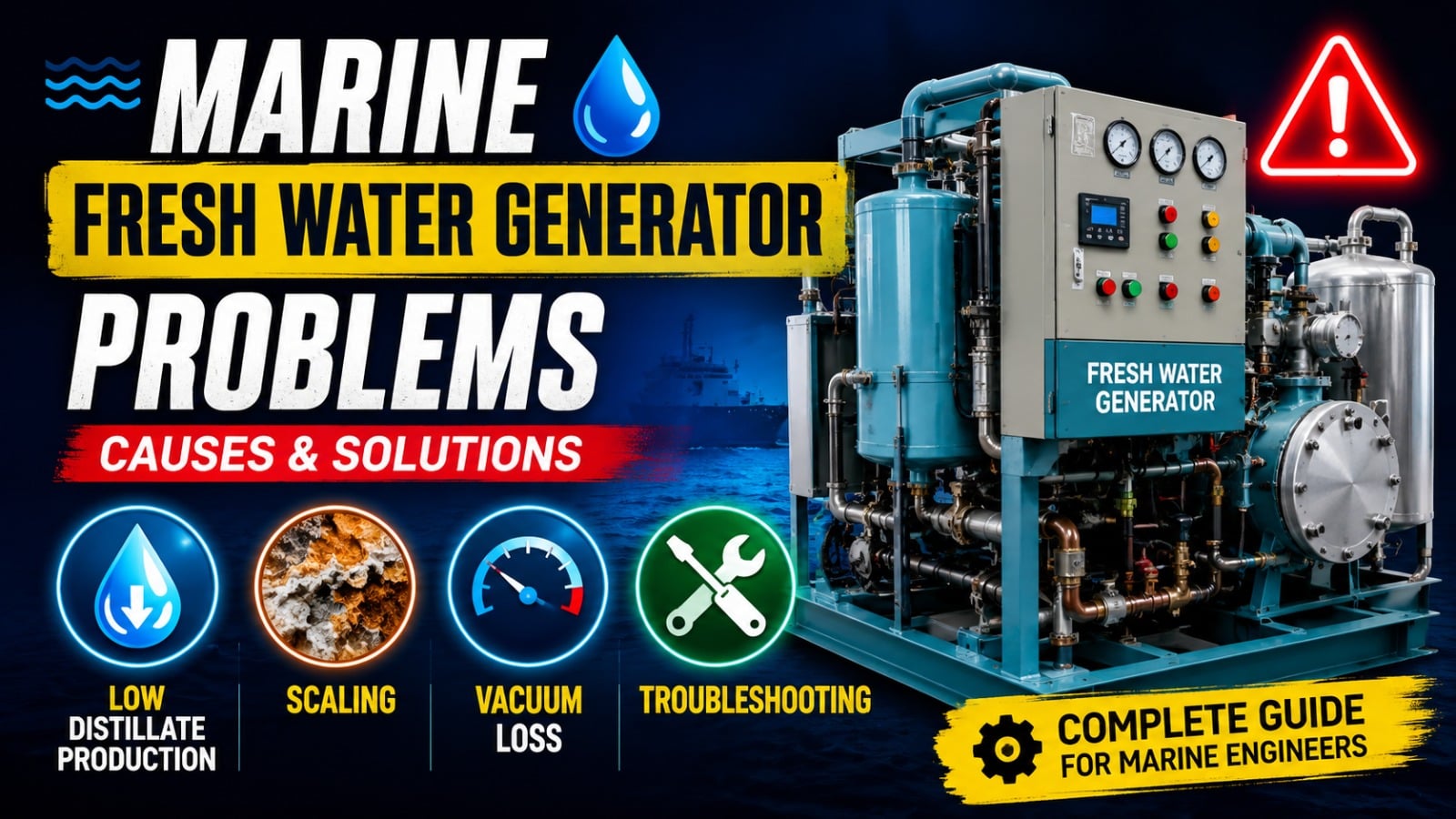
Introduction
A fresh water generator is one of those machines nobody thinks about until the water meter stops climbing. Then the emails start: production down from 22 tonnes to 9 overnight, salinity readings creeping past the alarm point, or vacuum that will not settle no matter what the second engineer does to the ejector.
Most fresh water generator problems fall into four buckets — lost vacuum, scaled evaporator plates, wrong feed rate, or a tired ejector. The tricky part is that the symptoms overlap. A plate pack choked with scale looks a lot like an air leak. A flooded evaporator looks a lot like a failed demister. This article breaks the plant down into the parts that actually fail, explains why output drops, and gives you a diagnostic path that starts with the cheapest checks and ends with opening the plate pack.
How a Marine Fresh Water Generator Works
The idea is simple: boil sea water at a temperature low enough to use waste heat, then condense the vapour into distillate. To boil water at 40°C instead of 100°C, you drop the pressure. A plate-type plant runs at roughly 90 to 94% vacuum, which puts the boiling point somewhere between 35 and 45°C — comfortably below the 75 to 85°C jacket cooling water coming off the main engine.
The flow path goes like this:
- Evaporation: Sea water feed passes over one side of titanium plates; hot jacket water flows through the other side. Part of the feed flashes to vapour.
- Vacuum creation: A combined air/brine ejector, driven by high-pressure sea water from a motor pump, pulls non-condensable gases and excess brine out of the shell and overboard.
- Seawater feed: Feed enters through an orifice or metering arrangement. Too much feed floods the plates and carries droplets over; too little leaves dry hot spots that scale fast.
- Distillate collection: Vapour passes through a demister that strips entrained brine droplets, then condenses on the condenser section. The distillate pump draws it off through a salinity sensor.
- Brine discharge: The concentrated brine drops to the sump and leaves through the brine side of the ejector. Brine density control matters — heavy brine scales plates and degrades vacuum.
Salinity protection closes the loop: a salinometer watches the distillate line, and if the reading climbs past the setpoint (usually set between 1 and 4 ppm), a three-way valve dumps production to the bilge or dirty tank instead of the fresh water tanks. The plant keeps running; you just get nothing for your fuel.
Why Fresh Water Production Drops
Output rarely falls for one dramatic reason. It usually slides over weeks, or it falls off a cliff one morning. The cause profile looks different for each.
1. Loss of Vacuum
Vacuum is the whole game. Every point you lose raises the boiling temperature, and production follows the temperature gap between heating water and boiling point down. Two percent less vacuum can cost you a surprising slice of output.
Air leaks are the usual culprit — gaskets on the shell or inspection covers, a cracked sight glass, loose instrument fittings, a gland on the distillate pump pulling air under vacuum. The other classic is the ejector itself. If the driving water pressure has slipped below about 3 bar, or the nozzle and cone have worn after years of sandy sea water, the ejector simply cannot keep up with the air coming in.
2. Evaporator Scaling
Calcium carbonate and magnesium hydroxide precipitate out of sea water as it concentrates and warms. Scale is a poor conductor of heat, so a 0.5 mm crust on the plates forces the jacket water temperature up just to hold the same boiling rate. Left alone, it turns into the chalky white or brownish layer you find when you finally open the pack.
Scaling accelerates when the boiling temperature climbs (which is why a vacuum problem eventually becomes a scaling problem), when the brine gets too dense, and when feed is starved so parts of the plate run dry.
3. Incorrect Feed-Water Flow
Over-feed floods the evaporator, lifts brine droplets toward the demister, and drags vacuum down with the extra load on the ejector. Under-feed starves the plates, dries the hot zones, and bakes scale on. If someone has "adjusted" the feed orifice or a gasket has shifted, output can drop with nothing else actually wrong.
4. Low Heating Temperature
The plant needs jacket water hot enough and flowing. After an engine-side change — a new thermostatic valve, altered three-way valve settings, a by-pass opened after cooling system work — the FWG can quietly lose 10°C of heating temperature and 30% of output. Check what is actually arriving at the plant, not what the engine room control system says is leaving the engine.
5. Ejector Problems
The ejector does two jobs: pull air and push brine. A worn nozzle, a choked cone, a leaking suction line, or a sea water pump running below design pressure cripples both. Ejector wear is progressive — plants that run in muddy or sandy anchorages wear out ejector internals far faster than the maintenance schedule admits.
6. Plate Fouling on the Condenser Side
Less common, but real. If the condenser section fouls with slime or shellfish from the sea water side, vapour stops condensing, the shell pressure rises, and vacuum collapses. This shows up as a vacuum problem that no amount of ejector work will fix.
Common Warning Signs
- Slow, steady output decline over weeks: scaling or progressive ejector wear. Plan a clean and pull the ejector nozzle at the next opportunity.
- Sudden output collapse: air leak, gasket failure, feed orifice blocked, or a valve someone touched. Ask what changed first.
- Salinity creeping upward: early demister carryover, over-boiling, or a salinity electrode starting to foul. Do not just keep flushing the sensor and moving on.
- Vacuum gauge oscillating: feed surging, ejector hunting on low driving pressure, or a partly choked brine line.
- Distillate pump losing suction or cavitating: check the pump gland and the minimum water level in the condensate sump before condemning the pump.
- Jacket water temperature rising while the FWG runs: the plant is asking for more heat than it is converting — often scale, sometimes reduced heating flow.
Vacuum Troubleshooting
Work through this in order. It costs nothing but time until you get to the ejector strip-down.
- Trust the gauge? Vacuum gauges on FWGs live in a humid salt environment and fail quietly. Compare against a second gauge or a portable absolute pressure instrument before chasing ghosts.
- Decay test: Stop the plant, isolate the shell with the vent and drain valves closed, and watch the gauge. A sound plant loses only a small amount of vacuum over 30 minutes. A fast decay means air is getting in somewhere, and the rate tells you how big the leak is.
- Leak hunt: With the plant running and vacuum pulled, pass a flame or soap solution slowly around cover gaskets, the sight glass, instrument roots, and the distillate pump gland. Flame flicker or steady bubble growth marks the spot. Do not do this anywhere near the ejector discharge.
- Ejector driving pressure: Check the gauge at the ejector, not at the pump. You want the maker's figure — on most plants around 3 bar or slightly above at full flow. Low reading? Look at the pump, the suction strainer, and any throttled valves in between.
- Ejector internals: Strip the nozzle and cone. Even modest erosion of the nozzle edge wrecks the jet. Sand-scoured cones, chewed gaskets, and wrong reassembly (cone seated off-centre) are all regular finds. Renew worn parts — nozzle geometry is not a repair job with a file.
- Non-return valve: The NRV between ejector and overboard prevents back-flow. A stuck or leaking NRV shows up as vacuum that improves when you throttle the overboard and vanishes when you open it.
Scaling and Cleaning
Scale forms faster at higher boiling temperatures and higher brine density, so prevention starts with running the plant as designed: vacuum healthy, feed correct, and the salinity/brine controls actually working. If your plant has a chemical dosing arrangement, use it — an antiscalant or controlled acid dose keeps carbonate from cementing onto the plates.
For chemical cleaning, most crews circulate an inhibited sulphamic acid solution through the evaporator side at around 10% strength, warmed but not hot. Watch the strength — when the acid stops fizzing and the pH stops moving, it is spent. Neutralise with soda solution, flush thoroughly with fresh water, and test the drain before opening anything. If the plant has not been descaled in years, expect to repeat the circulation two or three times rather than one heroic overnight session.
For a mechanical clean on opening: the plates are titanium. No wire brushes, no steel scrapers, no chisels. Soft brushes, plastic scrapers, and a lot of patience. Inspect every gasket while the pack is open — a gasket that has gone hard and flat will leak air or let sea water into the jacket side, and you will be back inside in a month. Check plates for damage around the ports, and if a plate is suspected of leaking between circuits, a simple pressure test with the pack partially reassembled will find it. Chlorides rising in your jacket cooling water test is the fingerprint of a leaking evaporator plate; persistent high salinity in distillate points at the condenser section instead.
Salinity Problems
High salinity in the distillate has a short list of causes, and the pattern usually tells you which one:
- Demister damage or collapse: carryover of brine droplets straight into the condenser. Salinity high and stable, vacuum often slightly better than usual (less vapour resistance). Inspect the demister at every opportunity; a demister that has been knocked loose during a previous cleaning is not unusual.
- Over-boiling: heating water too hot or vacuum too high for the design — violent boiling throws droplets past the demister. Check jacket temperature at the plant and compare with the maker's curve.
- Over-feed: flooding pushes the water level up toward the demister. Correct the feed and watch salinity settle over a few hours.
- Fouled or failing salinity electrode: readings jump around or drift. Clean the electrode, then calibrate against a standard solution or a handheld salinity meter before you trust the plant again.
- Condenser leak: sea water entering the distillate directly. Suspect this when salinity is badly high and cannot be brought down by any of the above. A leak here usually needs the plate pack opened and the offending plate renewed.
Test the three-way divert valve regularly with the override. If the dump valve sticks in the "tanks" position, your next alarm is the purifier room complaining about oily water — or worse, a chemically tasting tank.
Inspection Procedure
- Shut down and isolate. Stop feed and ejector pump, close and lock the heating water valves, let the shell vent to atmosphere, and drain both circuits. Tag the valves — an FWG full of 80°C jacket water is not something you open by accident.
- External survey. Gaskets, sight glass, instrument roots, pump glands, and every joint downstream of the shell for salt crystal trails. Salt streaks mark air leaks and weeps you never see while running.
- Open the evaporator section. Photograph the plate faces before touching anything — the scale pattern tells you where feed distribution is failing. Middle plates scaling while edges stay clean points to an orifice or distribution problem, not chemistry.
- Clean and examine plates. Chemical clean in situ first, mechanical (soft) cleaning after. Inspect for pitting, port damage, and gasket groove corrosion.
- Ejector strip-down. Nozzle, cone, suction strainer, and driving water line. Renew worn internals as a set.
- Demister and condenser section. Check demister security and condition; backflush or clean the condenser sea water side; inspect distillate pump impeller and gland.
- Reassemble and test. Pull vacuum with the plant closed and do a decay check before introducing feed. Bring production up gradually, log output per hour, salinity, and jacket temperatures, and compare with the ship's own baseline figures.
FWG Troubleshooting Table
Symptom Likely Cause Recommended Check Output down, vacuum normal, jacket temp higher than usual Scale on evaporator plates Chemical descale; check boiling temp history; inspect plates on opening Vacuum low, output down, started suddenly Air leak at gaskets, sight glass, or pump gland Decay test; soap/flame check on joints; tighten or renew gaskets Vacuum low and falling steadily over months Ejector nozzle/cone wear; low driving pressure Gauge at ejector; strip nozzle and cone; check pump and suction strainer Distillate salinity above alarm, vacuum normal Demister carryover or over-boiling Inspect demister; verify heating water temperature and feed rate Salinity erratic, jumps between low and high Fouled salinity electrode Clean and recalibrate electrode against reference meter Vacuum unstable, hunting up and down Feed surging or brine line partly choked Check feed orifice and line; inspect brine ejector and overboard Chlorides rising in jacket cooling water Evaporator plate leak (sea water to jacket side) Pressure test plate pack; renew leaking plate and gasketMaintenance Checklist
Daily
- Log output (litres per hour or tonnes per day), vacuum %, salinity ppm, jacket water inlet/outlet temperatures, feed rate.
- Compare output against the ship's baseline for the same sea temperature. Investigate anything more than about 10% down.
- Watch the sight glass for foaming or violent boiling.
Weekly
- Clean the salinity electrode and confirm the alarm/divert function with the test button.
- Check ejector driving pressure at the ejector body.
- Walk the plant for new salt trails and weeps.
Monthly
- Vacuum decay test on the isolated shell.
- Check distillate pump performance and gland condition.
- Verify gauge readings against a reference instrument.
6-Monthly / Opportunity
- Chemical descale of the evaporator section based on production trend, not the calendar alone.
- Strip and inspect the ejector; renew nozzle and cone as a set when worn.
- Open the plate pack, renew doubtful gaskets, inspect demister, and check plate condition.
When plate packs, ejector internals, or a complete unit need renewal, quality fresh water generators and heat exchanger spares are part of our regular supply — including Alfa Laval, Atlas Copco, and Seres plate and gasket sets.
Frequently Asked Questions
Why does my FWG produce less water in warm tropical seas?
Warm sea water condenses vapour less effectively and gives the ejector a harder job. Every plant has a production curve against sea water temperature — expect the low end of the curve above 30°C inlet, and do not condemn the plant for doing what the curve says it will do.
What vacuum should a marine fresh water generator hold?
Most plate-type plants run between 90 and 94% vacuum, equivalent to roughly 0.06–0.10 bar absolute. Check your maker's plate, then hold the plant to that number. If vacuum decays quickly on a closed, isolated shell, you have an air leak or ejector trouble.
How often should the evaporator plates be chemically cleaned?
Let the production trend decide. Ships running with healthy vacuum and good feed control get years between cleans; plants that run hot or with poor vacuum need descaling once or twice a year. A fall in output at normal vacuum and heating temperature is your signal.
Can I use the FWG when the main engine is running at low load?
Only if the jacket water stays hot enough. Below roughly 55–60°C at the plant inlet, boiling becomes marginal and production drops away quickly. Some plants allow a heater backup or a steam supply for such periods — check your arrangement before promising the chief a full tank by morning.
Is a little scale on the plates really a problem?
Yes, because scale begets scale. The first layer raises the boiling temperature, which accelerates further deposition, and the plant slides into a cycle of rising temperature and falling output. Clean at the first sign, not when the plates look like chalk.
Why is my distillate salinity high but the vacuum looks better than normal?
That combination usually means droplets are reaching the condenser — a damaged or displaced demister, or violent boiling from over-feed and over-temperature. Less vapour resistance through a damaged demister can even show a slightly higher vacuum. Inspect the demister before touching the salinometer.
What is the fastest check when production suddenly drops?
Ask what changed. Someone touched a valve, a pump was swapped, the engine shifted load. Then read the three numbers that matter — vacuum, jacket temperature at the plant, and salinity — in that order. Nine times out of ten, the fault is visible in those three readings before you open a single flange.