The Governor's Function
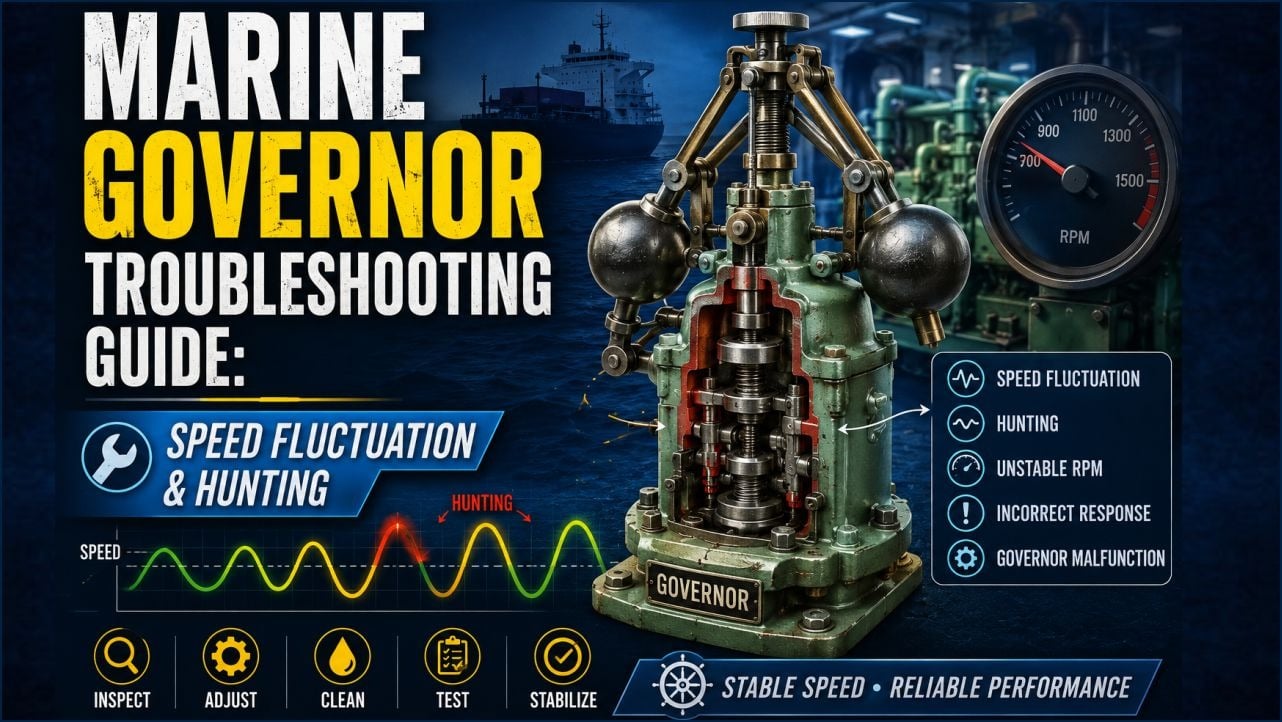
The governor is the brain of the marine diesel engine's fuel system. Its primary job is to automatically adjust the fuel rack position to maintain a set engine speed, regardless of changes in engine load (like heavy seas or cargo operations). A well-functioning governor ensures stable power delivery, whereas a faulty one can lead to erratic operation and, in worst-case scenarios, destructive overspeeding.
Mechanical vs. Hydraulic Governors
While older or smaller emergency generators might still use purely mechanical governors (relying on centrifugal flyweights), most modern main engines and large auxiliaries use hydraulic or electro-hydraulic governors (like the classic Woodward governors). Hydraulic governors use oil pressure to provide the significant force needed to move heavy fuel racks, offering much finer control and faster response times than mechanical counterparts.
Symptoms of Hunting
"Hunting" is one of the most common complaints. This is when the engine speed continuously fluctuates up and down around the set point, unable to settle. You can literally hear the engine revving and dying back down, and you will see the governor terminal shaft (and the fuel rack) oscillating continuously.
Speed Instability Causes
Speed instability and hunting are rarely caused by a single, obvious failure. Common culprits include:
- Contaminated or Degraded Governor Oil: Dirt or sludgy oil causes the delicate internal pilot valves to stick.
- Incorrect Compensation Adjustments: The needle valve (compensation valve) regulates the reaction speed. If it's too far open or closed, the governor will overcorrect.
- Sticking Fuel Rack: If the engine's fuel linkage is stiff or binding, the governor has to fight it, leading to delayed, jerky movements.
- Air in the Governor Oil: Aerated oil acts like a sponge, causing a spongy, delayed response.
Addressing Overspeed Problems
An engine overspeed is incredibly dangerous and can result in severe mechanical damage (e.g., throwing a con-rod). If an engine overspeeds, it means the governor failed to pull the fuel rack to zero when the load dropped. This can be due to a catastrophic internal mechanical failure of the governor, a completely seized fuel rack, or a failure in the electronic speed sensing circuit (on electro-hydraulic models).
Inspection Procedure
Before touching the governor itself, always check the external linkage. Disconnect the governor from the fuel rack and move the rack by hand. It should move smoothly from zero to maximum without any tight spots. Next, check the governor oil level and condition. Is it dark, milky, or smelling burnt? If so, flush and replace it immediately with the manufacturer's recommended grade.
Maintenance Checklist
- Regularly check and top up the governor oil level.
- Drain, flush, and refill the oil at the specified running hours.
- Lubricate all external fuel linkages and rod ends.
- Check for any oil leaks around the terminal shaft.
- Ensure the compensation needle valve is set correctly (only adjust if you know what you are doing, usually 1/2 to 1 turn open).
Frequently Asked Questions
How do I bleed air from a hydraulic governor?
Usually, running the engine at low load and manually opening the compensation needle valve a few turns for a short period will allow trapped air to bypass and escape. Remember to return the needle valve to its original position.
Can I use standard engine oil in the governor?
No. Governors require specific oil with the correct viscosity and anti-foaming properties. Using engine oil can cause sticking internal parts and erratic behavior.