The Extreme Environment of the Piston Crown
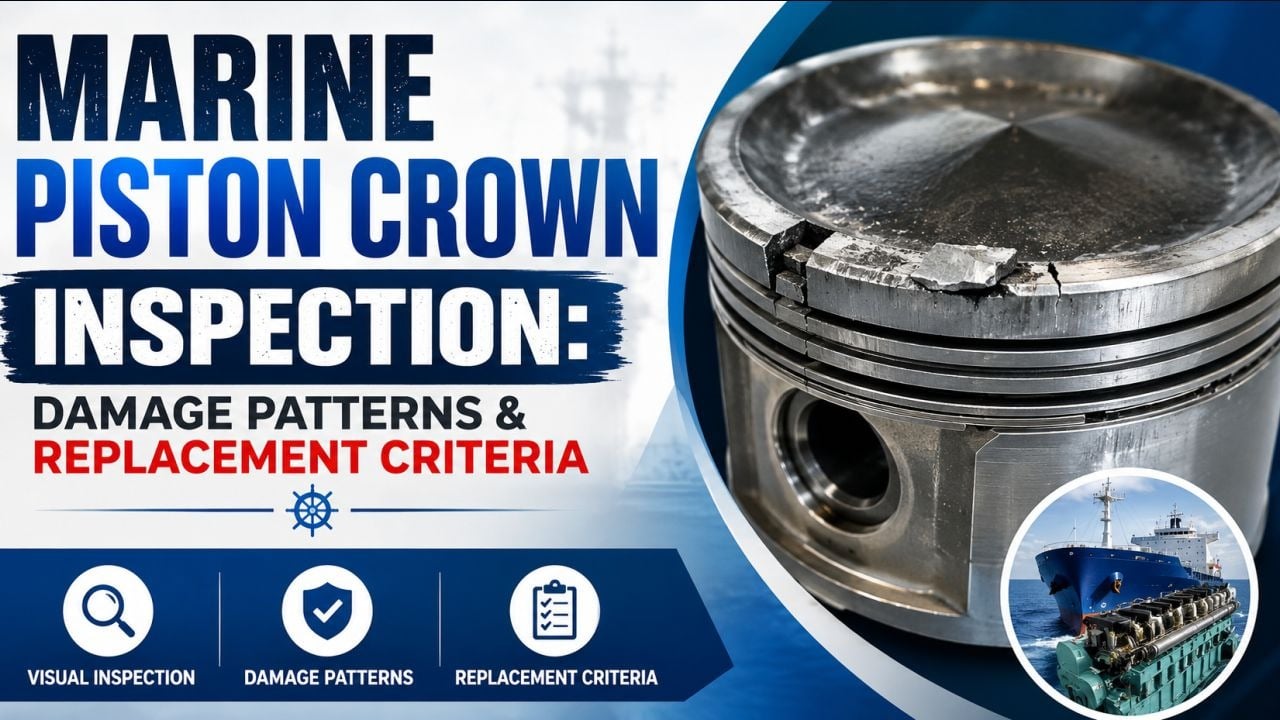
The piston crown is subjected to the harshest environment in the engine room. It bears the full force of peak firing pressures and endures temperatures exceeding 1500°C during combustion. Because of these extreme mechanical and thermal stresses, marine piston crowns are typically forged from high-temperature alloy steel. However, even the toughest crowns degrade over time. Thorough inspection during overhaul is critical to determine if a crown can be reused, reconditioned, or scrapped.
Thermal Cracking
Thermal cracks, sometimes called "star cracks," usually originate at the center of the crown where the fuel injector sprays, or around the lifting holes. These are caused by severe temperature fluctuations—such as rapid load changes or localized overheating from poor fuel atomization. During inspection, the crown should be thoroughly cleaned and subjected to dye penetrant testing (PT) or magnetic particle inspection (MPI) to reveal micro-cracks that are invisible to the naked eye.
Crown Erosion and Burning
High-temperature corrosion, commonly known as crown burning, occurs when fuel containing high levels of vanadium and sodium burns, forming highly corrosive ash. This ash melts onto the crown, eating away the metal. It often looks like a localized depression or melted patch on the top surface. If the erosion exceeds the manufacturer's maximum allowed depth (usually a few millimeters), the crown must be reconditioned by welding and machining.
Cooling Gallery Blockage
The underside of the crown relies on a flow of cooling oil (or water, in older designs) to manage its temperature. The cooling galleries can become blocked with baked-on carbon or sludge if the cooling oil degrades or if the engine runs excessively hot. During overhaul, the crown must be separated from the skirt, and the cooling spaces must be chemically cleaned and visually inspected. A blocked cooling gallery will rapidly lead to crown failure due to thermal stress.
Carbon Build-up and Scuffing
Excessive carbon on the top land (the vertical edge above the first ring groove) can rub against the cylinder liner, causing polishing and scuffing. This destroys the lubricating oil film. Engineers should measure the diameter of the top land and check for severe hard carbon deposits.
Inspection Checklist
- Clean the combustion surface to bare metal for NDT (Non-Destructive Testing).
- Use dye penetrant to check for thermal cracks around lifting holes and the center plate.
- Measure the depth of any high-temperature burning or erosion.
- Inspect ring grooves for excessive vertical wear using a calibrated clearance gauge (feeler gauge).
- Dismantle the piston and aggressively clean the internal cooling galleries. Check the condition of the O-rings sealing the cooling space.
Replacement Criteria
Reconditioning is common, but a crown is usually condemned if cracks extend deeply into the cooling gallery, if the ring groove wear exceeds the limit for an oversize ring, or if the overall thickness has been reduced beyond Class specifications by repeated machining. Always refer to the engine builder's manual for specific dimensional limits.