Introduction
The stern tube bearing and seal arrangement forms the critical mechanical boundary between a vessel's engine room and the surrounding sea. Operating under continuous hydrodynamic load, dynamic wave action, and hydrostatic pressure, this system must support the substantial overhung mass of the propeller while preventing lubricating oil from escaping into the ocean and seawater from breaching the hull.
When stern tube bearing leakage develops, the consequences escalate rapidly. Uncontrolled oil loss violates strict international environmental regulations, including MARPOL Annex I and the US EPA Vessel General Permit (VGP), risking severe fines and vessel detentions. Simultaneously, seawater ingress emulsifies the stern tube lubricating oil, destroying the hydrodynamic oil film and initiating rapid white-metal wiping, shaft sleeve grooving, and catastrophic shaft seizure. Timely detection and structured repair decisions are essential to safeguard the propulsion train.
What the Stern Tube Bearing System Does
To diagnose faults accurately, marine engineers must evaluate how the three primary functions of the stern tube assembly interact under operational loads:
- Propeller Shaft Support: The forward and aft stern tube bearings (traditionally lined with white metal / Babbitt alloy, synthetic polymers, or composite bushes) carry the weight of the intermediate and tailshaft, absorbing heavy radial forces generated by the rotating propeller.
- Hydrodynamic Lubrication Maintenance: The system maintains a pressurized oil wedge between the rotating shaft sleeve and the stationary bearing bush. Oil circulation is regulated by low- and high-gravity header tanks that maintain a positive differential pressure of 0.15 to 0.30 bar above the external sea water head.
- Shaft Line Alignment Protection: Stern tube bearings hold the tailshaft in precise alignment with the intermediate shaft and main engine crankshaft, accommodating hull flexure between ballast and laden sea passages.
Early Warning Signs of Stern Tube Leakage
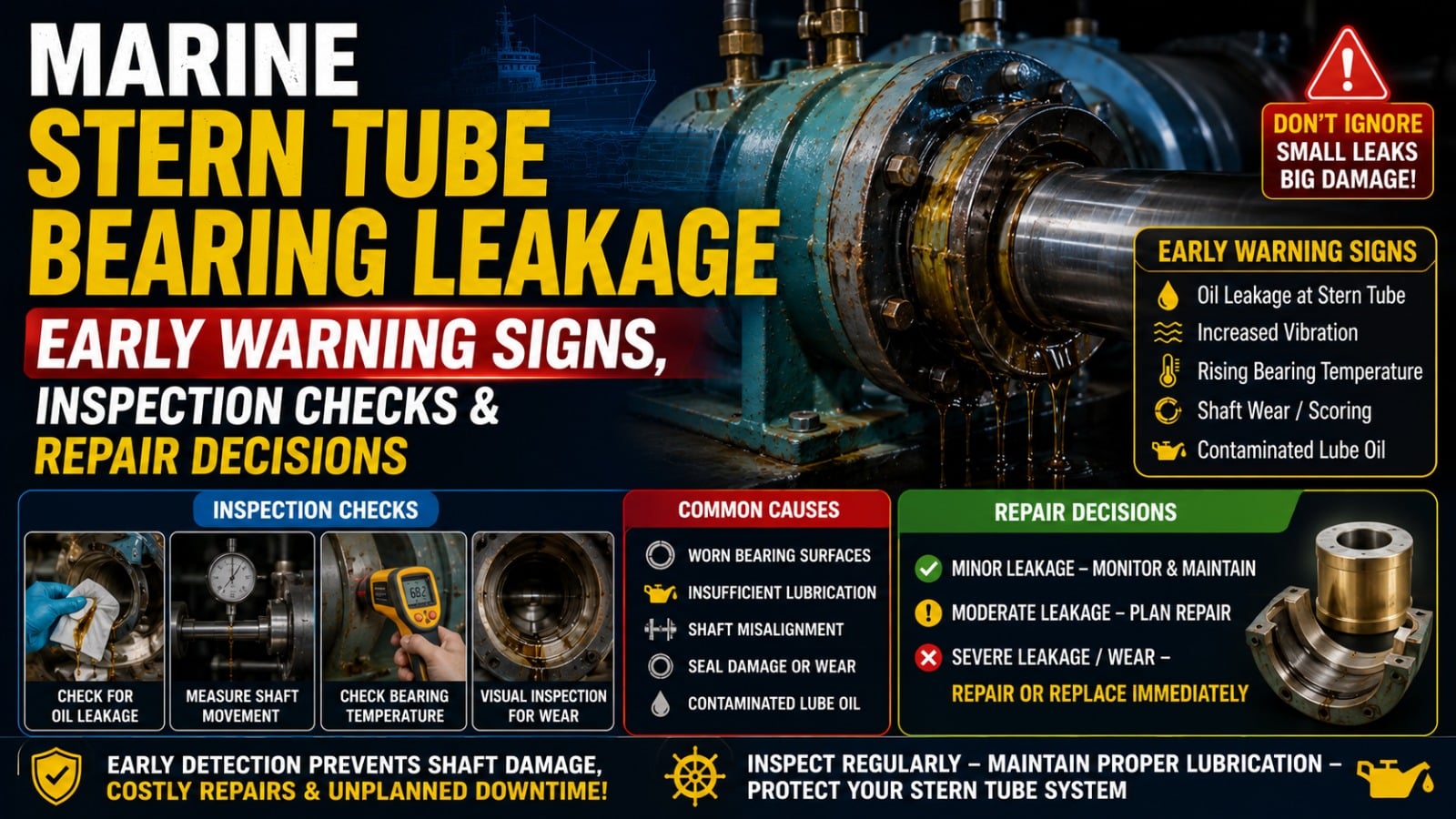
Stern tube failures rarely happen without preceding operational indicators. Watch for these five warning signs during daily watchkeeping:
- Gravity Tank Level Fluctuations: An unexplained drop in the stern tube lubricating oil header tank indicates oil loss to the sea through worn aft seals or into the engine room bilges through the forward seal. Conversely, a rising header tank level signals that external seawater pressure has overcome internal oil pressure, forcing water into the system.
- Lubricating Oil Emulsification & Discoloration: Clear, amber stern tube oil turning milky, cloudy, or hazy is a confirmed symptom of water ingress. Routine onboard crackle tests or chemical reagent water-in-oil tests will reveal moisture content exceeding normal operational thresholds (>0.10%).
- Aft Bearing Temperature Rise: A steady upward trend in the aft bearing embedded PT100 temperature sensors—especially temperatures exceeding 55°C to 65°C or running 15°C above baseline seawater temperatures—indicates thinning oil viscosity or boundary metal-to-metal contact.
- Shaft Line Vibration & Rumbling Noise: Excessive bearing clearance or eccentric shaft rotation produces distinct low-frequency rumbling and elevated radial vibration readings on the shaft line at specific engine RPM bands.
- Visible Sheen Around Propeller Boss: Periodic underwater inspections, diver surveys, or observations during shallow-draft ballast conditions that reveal oil sheens or dark grease tracks around the rope guard confirm active aft seal leakage.
Common Causes of Bearing & Seal Failure
Identifying the root cause dictates whether the vessel requires simple operational mitigation or immediate shipyard intervention.
1. Lip Seal Ring Wear and Hardening
Modern lip-type stern tube seal assemblies (such as Simplex-Compact or Kobelco designs) employ multi-ring arrangements made of fluoroelastomers (FKM/Viton) or nitrile rubber (NBR). Over thousands of operating hours, frictional heat and age harden the elastomeric lip edges, causing them to lose elasticity and fail to conform to shaft runout.
2. Shaft Sleeve Grooving & Scoring
The rotating chrome-steel or stainless-steel shaft sleeve directly under the seal lips suffers abrasive wear. Suspended silt, sand, and fine marine sediments trapped beneath the garter springs cut circumferential grooves into the sleeve surface, allowing oil and water to bypass the seal boundary.
3. Fishing Nets and Monofilament Entanglement
Discarded synthetic fishing nets and monofilament lines frequently migrate behind the propeller rope guard. Under rotational force, these lines wrap tightly around the shaft sleeve, melt due to frictional heat, and sever the aft seal lip rings, causing sudden and severe oil discharge.
4. Shaft Misalignment and Hull Deflection
Improper chocking, uneven cargo loading, or severe heavy-weather hull flexing alters the contact angle between the tailshaft journal and the aft bearing. Edge loading concentrates extreme point pressures on the aft-most section of the white metal, wiping the bearing material and forcing the shaft off-center against the seal rings.
Onboard Inspection Procedure
When stern tube leakage or temperature alarms occur, execute this structured inspection protocol:
- Forward Seal Inspection: Examine the forward seal housing in the engine room tunnel. Check the drain catch-pot for active oil leakage, water presence, or garter spring displacement. Measure housing temperature using an infrared thermometer.
- Oil Sampling and Analysis: Draw bottom samples from the stern tube gravity tank, the forward seal drain, and the main circulating loop. Conduct an immediate onboard water-in-oil test. Send split samples to an accredited laboratory for particle spectroscopy, testing for tin (Sn), lead (Pb), and copper (Cu) wear metals.
- Differential Pressure Verification: Verify the static head of the header tanks against the vessel's current draft. Ensure the header tank oil level provides a minimum 0.2 bar overpressure relative to external sea water pressure at the shaft centerline.
- Poker Gauge / Wear-Down Measurement: During port stays or trim adjustments where the propeller is accessible, take poker gauge readings at the top and bottom of the aft bearing bush to measure shaft drop and verify residual bearing clearance.
- Vibration and Temperature Trending: Record shaft vibration spectra across multiple load profiles and cross-reference bearing temperature trends against engine output and seawater ambient temperature.
Repair Decision Matrix: Monitor, In-Situ, or Drydock?
Chief engineers and technical superintendents must select the correct corrective action based on data severity:
Level 1: Operational Monitoring & Fluid Management
If water content is minimal (<0.5%) and oil consumption is under 2–5 liters per day:
- Engage onboard centrifugal purifiers or continuous offline oil dehydration units to extract free and emulsified water.
- Adjust header tank gravity pressure or regulate air control pressure on air-space seal systems.
- Switch to a higher-viscosity Environmentally Acceptable Lubricant (EAL) approved by the seal and bearing maker.
Level 2: In-Situ / Afloat Resealing
If aft seal leakage persists but the shaft sleeve and white metal bearings are structurally sound:
- Engage certified diving teams equipped with specialized underwater habitat chambers to bond new split Viton seal rings without withdrawing the tailshaft.
- Utilize inflatable standby emergency seals to isolate the stern tube while replacing forward seal rings in the shaft tunnel.
- Shift the seal casing axially (using spacer rings) to reposition the new seal lips onto unworn sections of the shaft sleeve.
Level 3: Emergency Drydock Intervention
Mandatory when wear-down gauge readings exceed maximum class limits, lab analysis shows severe white-metal wiping, or oil leakage cannot be arrested:
- Withdraw the propeller and tailshaft for non-destructive testing (MPI/UT) and dimensional calibration.
- Machine or replace the scored chrome-steel shaft sleeve.
- Re-metal and line-bore the stern tube bearing bushes to restore OEM design clearances.
- Perform complete optical or laser shaft alignment checks from the main engine flywheel to the stern tube aft bush.
Stern Tube Troubleshooting Table
Symptom / Alarm Likely Root Cause Immediate Onboard Action Permanent Repair Action Gravity tank level dropping rapidly Aft lip seal ring tear or netting entanglement Check draft pressure; inspect wake for sheen; activate emergency air seal if fitted Afloat split-ring renewal or drydock seal replacement Gravity tank level rising; cloudy oil Aft water seal ring failure; insufficient oil head Raise header tank level; run LO separator/dehydrator continuously Renew seal rings; flush and charge system with fresh oil Aft bearing temp >65°C under normal load Shaft misalignment; edge loading; loss of oil film Reduce engine RPM; verify oil flow; take oil sample for metal analysis Shaft alignment verification; bearing re-metalling in drydock High tin/lead PPM in laboratory sample White metal bearing wiping / boundary friction Inspect magnetic plugs; verify poker gauge wear-down; monitor vibration Tailshaft withdrawal and bearing replacement Continuous oil dripping from forward seal Forward seal lip hardening or garter spring failure Direct drain to recovery tank; verify tunnel bilge cleanliness Replace forward split seal rings in-situ in engine roomFrequently Asked Questions
What is the acceptable water content limit in stern tube lubricating oil?Most marine engine and bearing manufacturers recommend keeping water content below 0.10% (1,000 ppm). If moisture exceeds 0.20%, an alarm condition exists requiring purification. At levels exceeding 0.50%, the hydrodynamic load capacity drops drastically, requiring immediate oil batch renewal or offline dehydration to prevent bearing wiping.
How does a poker gauge measure stern tube bearing wear-down?A poker gauge (or depth micrometer) is inserted through a dedicated access plug on the aft seal casing to measure the precise clearance between the top of the shaft sleeve and the bearing housing. Comparing this measurement to the baseline recorded at the previous drydock indicates the exact vertical drop of the shaft caused by white metal wear.
Can stern tube seals be replaced without drydocking the vessel?Yes. Certified commercial diving companies can install a specialized underwater habitat around the propeller shaft boss. Once dewatered, technicians bond vulcanized split Viton seal rings around the shaft. Furthermore, the forward seal inside the engine room tunnel can almost always be overhauled afloat using standby split rings.
Why do Environmentally Acceptable Lubricants (EAL) sometimes increase seal wear?Certain synthetic ester-based EALs are prone to hydrolytic degradation in the presence of water, forming acidic byproducts that attack standard NBR and early-generation FKM elastomers. When operating with bio-oils, vessels must verify that all installed lip seal rings are constructed from specialized, hydrolysis-resistant fluoroelastomer grades (FKM-EAL).
What is the function of the spacer ring in a stern tube seal housing?A spacer ring (distance piece) is fitted between seal housing flanges to position the seal lips on pristine areas of the shaft sleeve. When the sleeve develops wear grooves under the lips during operation, removing or adding a spacer shifts the entire seal housing axially by several millimeters, seating the lips on fresh metal without requiring sleeve remachining.
What differential pressure should be maintained on stern tube header tanks?The oil level in the stern tube gravity tank should be configured to maintain a static head pressure of approximately 0.15 to 0.30 bar (1.5 to 3.0 meters of oil head) above the maximum loaded seawater waterline at the shaft centerline. This ensures positive outward pressure to prevent seawater ingress while avoiding excessive pressure that could distort the elastomeric seal lips.