Introduction
When a marine diesel engine piston is lifted from the cylinder during an overhaul, the piston ring inspection is one of the most information-dense activities an engineer will perform during that entire job. The condition of the rings — and the precise measurements taken from them — determine whether the engine returns to service with restored compression or continues to haemorrhage blow-by past worn sealing surfaces. More importantly, ring measurement data identifies whether the fault lies with the rings themselves, the ring grooves in the piston crown, or the cylinder liner wall — three separate wear surfaces that must be evaluated independently.
Piston ring measurement is not difficult. It requires two or three quality instruments, a clean bench, good lighting, and the discipline to follow a systematic procedure. This guide walks through the complete measurement workflow that professional marine engineers use during major overhauls, with the measurement techniques, acceptance limits, and replacement criteria that matter in practice.
The Purpose and Function of Marine Diesel Piston Rings
Understanding what piston rings are supposed to do makes it immediately obvious why their precise dimensions are critical:
- Compression sealing: The primary compression rings prevent the high-pressure combustion gas from escaping past the piston into the crankcase. They must maintain gas-tight contact against the liner wall throughout the entire piston stroke, despite the rapid changes in gas pressure acting upon them.
- Heat transfer: Piston crowns reach temperatures of 300–450°C in a medium-speed diesel engine. The piston rings are the primary thermal pathway conducting this heat away from the piston crown — through the liner wall — to the cooling water. A ring that is not in continuous contact with the liner wall cannot conduct heat effectively, and the piston crown temperature rises until the piston begins to distort or crack.
- Oil control: The lower oil-control rings (in four-stroke engines) scrape excess lubricating oil from the liner wall on the downstroke, returning it to the crankcase. They must also allow a precisely calibrated thin film of oil to remain on the liner wall to lubricate the ring-liner interface. Too little oil causes adhesive wear; too much oil means excessive oil consumption and fouled combustion chambers.
Types of Piston Ring Wear in Marine Engines
Ring wear is not a single uniform phenomenon. Recognising which type of wear is present tells the engineer what is causing it:
- Normal abrasive wear: The gradual loss of ring width and the wearing of the barrel profile on the ring face. This is expected and managed through scheduled replacement at the builder's defined wear limits.
- Accelerated abrasive wear: Caused by abrasive contamination — cat-fines from heavy fuel oil, dirt through a failed inlet air filter, or metallic debris from another engine failure. The wear rate is abnormally high, and the ring face will show deep, vertical scratching rather than the smooth, gradual profile loss of normal wear.
- Corrosive wear: Sulphuric acid attack on the ring face from inadequate cylinder lube oil alkalinity on high-sulphur fuel operations. The ring face shows a rough, pitted, matte texture rather than the smooth surface of abrasive or adhesive wear.
- Ring face micro-seizure (scuffing): When the oil film between ring and liner collapses locally, metal-to-metal contact causes micro-welds that immediately tear apart as the piston moves. The ring face develops a rough, torn, sometimes shiny appearance in localised patches. This is the precursor to full scuffing.
- Groove wear: The ring groove flanks in the piston crown wear on their upper and lower bearing faces. This allows the ring to move radially in the groove (pumping motion) rather than maintaining stable sealing contact — causing oil consumption and reduced compression.
Measurement 1: Ring End Gap
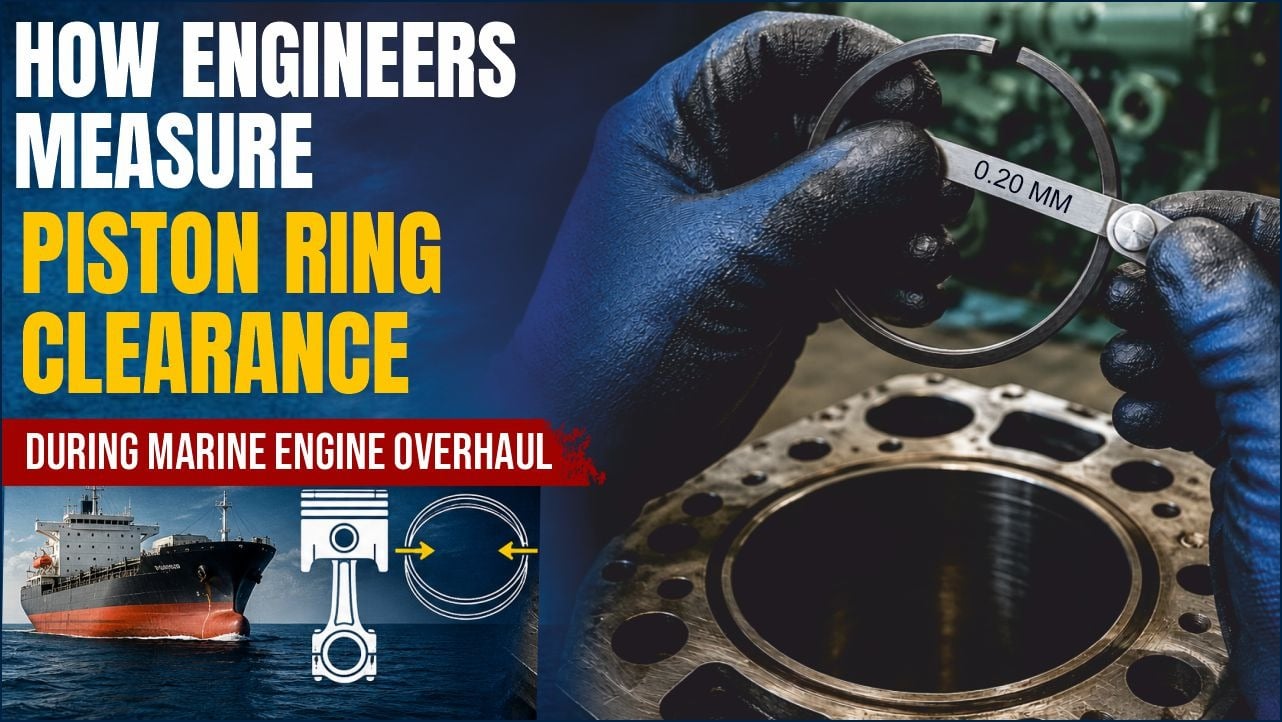
Ring end gap is the most fundamental and most frequently checked piston ring measurement. It measures how much space exists between the two ends of the ring when the ring is inserted squarely into the cylinder liner.
Why it matters: As the ring wears, its outer diameter decreases and the end gap increases. An excessive end gap means the ring can no longer expand fully against the liner wall, and combustion gas can bypass the ring through this gap. The measurement tells you whether the ring itself is worn out, regardless of the condition of the liner or the grooves.
Correct measurement procedure:
- Clean the ring thoroughly — any carbon or oil deposit will compromise the measurement.
- Insert the ring squarely into the cylinder liner bore. To ensure it is perfectly perpendicular to the bore axis, use the piston itself (without rings) to push the ring to a position approximately 10–20 mm below the top of the piston travel — a worn zone in the liner. Do not measure in the top zone of the liner, which is the most worn area and will give an artificially large gap reading. Many builders specify measuring at approximately 50 mm from the top of the liner.
- With the ring sitting squarely in the liner, insert feeler gauges between the ring ends. Start with a thin feeler blade and add until there is a definite drag without forcing.
- Record the gap. Compare with the builder's specifications: minimum permissible gap (below which the ring could seize by thermal expansion in service) and maximum permissible gap (above which blow-by is excessive).
Typical reference values (guide only — always use OEM manual):
Engine Bore Diameter New Ring Minimum Gap Maximum Permissible Gap (Wear Limit) Up to 200 mm 0.20–0.40 mm 1.0–1.5 mm 200–400 mm 0.40–0.70 mm 1.5–2.5 mm Over 400 mm (large slow-speed 2-stroke) 0.70–1.50 mm 3.0–6.0 mm (varies significantly)Measurement 2: Ring Side Clearance
Side clearance is the axial gap between the ring's upper or lower face and the corresponding groove flank in the piston. This gap allows the ring to move radially (in and out) in the groove — essential for its sealing function. But when the gap becomes excessive, the ring can also move axially in the groove, which causes oil to be pumped past it and prevents the ring from forming a stable gas seal.
Correct measurement procedure:
- Fit the ring into its groove (without installing it in the liner).
- Using a feeler gauge, measure the gap between the upper ring face and the upper groove flank, going around the circumference at three or four positions. Record the maximum reading.
- Compare the maximum measured side clearance with the builder's wear limits. A side clearance that exceeds the limit means that either the ring is undersized (new rings needed) or the groove has worn (piston crown needs replacement or re-grooving).
Key distinction: Always measure side clearance with a new ring in an old groove to determine whether the groove has worn. If side clearance is excessive with a brand new ring, the groove is worn and a new ring will not fix the problem — the piston must be replaced or the groove repaired.
Measurement 3: Groove Wear
The ring grooves in the piston crown wear on their upper (pressure) face — the face against which the ring presses under combustion pressure. Groove wear allows the ring to sink slightly lower in its groove than intended, misaligning the ring's position relative to the liner bore and changing the oil film dynamics.
Measurement method: Use a ring groove wear gauge — a simple stepped gauge that fits into the groove to measure groove width. Alternatively, use a calibrated depth micrometer and ruler to measure groove width at multiple positions around the circumference. Compare with the new groove width from the OEM manual. The difference between measured width and new-groove width is the groove wear.
Decision rule: If groove wear exceeds the builder's permissible limit, fitting a new ring set into the worn grooves is wasteful — the new rings will have excessive side clearance from day one and will wear rapidly. The piston crown must be replaced, or the grooves must be machined and oversized rings fitted (if the OEM permits this).
Replacement Criteria — When to Replace Rings vs. When to Replace the Piston
- Replace rings only: Ring end gap exceeds the maximum but side clearance is within limits with a new ring. Groove wear is within limits.
- Replace rings and inspect the liner: Ring end gap significantly exceeds maximum, indicating the liner bore has also worn and pushed the gap beyond the ring's own wear. Confirm liner bore measurements before ordering new rings.
- Replace the piston crown: Side clearance exceeds the maximum even with a brand new ring — the grooves are worn beyond useful dimensions.
- Replace everything (piston, rings, and liner): Liner bore exceeds maximum wear limit simultaneously with piston and ring failures — the engine has been run well past its overhaul interval.
Piston Ring Inspection Checklist
- ☑ Before removal: photograph the ring pack in position — note which face faces upward (some rings are directional)
- ☑ Label removed rings by ring number and piston number — do not mix up rings between cylinders
- ☑ Inspect ring face profile — barrel profile should be visible; flat face indicates worn profile
- ☑ Measure ring end gap — record in worn liner position AND in the liner's minimum wear position (if accessible)
- ☑ Measure ring side clearance with old ring in groove
- ☑ Measure ring side clearance with new ring in groove — compare with old ring measurement to isolate ring wear vs. groove wear
- ☑ Measure ring groove width with groove gauge or micrometer
- ☑ Inspect ring faces for scuffing, corrosion pitting, or abrasive scoring — photograph any abnormal surface condition
- ☑ Check ring pegs (if fitted) for condition — a broken peg allows the ring to rotate into the port cut-outs in two-stroke liners, causing immediate ring breakage
- ☑ All measurements recorded and compared against OEM acceptance limits in the overhaul record
- ☑ Replacement rings checked for correct part number, grade, and markings before installation
- ☑ New rings installed with correct facing up (check maker's marking — often "TOP" or a triangular stamp)
- ☑ Ring end gaps staggered during installation — never allow two ring gaps to align on the same side
Frequently Asked Questions
What happens if new rings are fitted into an oversized or worn cylinder liner?New rings fitted into a liner that has already worn beyond its limits will have an end gap that immediately exceeds the maximum permissible value — even on the first day of service. The excess gap means blow-by continues, compression is not restored, and the new rings will wear even faster than the original set because the worn, out-of-round liner does not provide a uniform seating surface for the ring face. Never fit new rings without confirming that the liner bore measurements are within specification.
Can piston rings be re-used if the engine is partially overhauled?In principle, if rings are measured and fall within the permissible limits for end gap, side clearance, and face condition, they can be refitted — but only in their original positions (same cylinder, same ring groove, same orientation). Rings take a "set" against the liner bore and groove shape over time. Fitting a used ring into a different cylinder introduces a break-in period and risks compression loss. In practice, most major overhauls replace the ring pack as a matter of routine because the cost of the rings is small relative to the cost of the overhaul labour and the risk of having to redo the work due to residual ring wear.
What is the difference between a compression ring and an oil control ring?Compression rings sit in the upper grooves of the piston crown, closest to the combustion chamber. Their primary job is gas sealing. They typically have a barrel-shaped or tapered outer profile to promote hydrodynamic oil film formation and are made from cast iron or ductile iron with surface treatments (chrome plating, plasma coating) to resist wear. Oil control rings sit in the lower grooves, further from the combustion chamber. Their job is to scrape excess oil from the liner wall and control the oil film thickness. They typically have two scraping lands with a slotted or coiled expander spring behind them to maintain radial pressure against the liner.
How do I know if the correct cylinder lubricant feed rate is set for my engine?The cylinder lubricant feed rate is expressed in grams per kilowatt-hour (g/kWh) and is set based on the fuel sulphur content and the engine load. Too low a feed rate causes inadequate oil film formation and accelerated ring and liner wear. Too high a feed rate causes oil fouling of the exhaust system, carbon deposits in the ring grooves (eventually causing ring sticking), and excessive operating cost. Most modern electronically controlled engines have load-dependent variable cylinder lube systems. For older engines with fixed mechanically driven lubricators, the feed rate is typically set during commissioning and must be reviewed whenever the fuel sulphur specification changes.
Why must ring end gaps be staggered when the rings are fitted?If two ring end gaps are aligned on the same side of the piston, there is a direct linear path for combustion gas to flow from the combustion chamber, through the first ring gap, into the inter-ring space, and straight out through the second ring gap into the crankcase. By staggering the gaps — typically 90–120 degrees apart — this direct leakage path is eliminated. Gas attempting to blow by must travel around the circumference of the ring before it can reach the next gap, dramatically reducing blow-by even when the rings have some wear.