Introduction
A marine engine overhaul is one of the most capital-intensive and critical maintenance operations in a vessel's lifecycle. Operating a main propulsion engine beyond its prescribed running hours without major maintenance inevitably leads to thermal fatigue, catastrophic component failure, and prolonged off-hire periods. For ship owners and technical superintendents, an overhaul is not merely a mechanical necessity—it is a complex logistical operation that requires precise alignment of spare parts procurement, specialized labor, and operational downtime. Understanding exactly what transpires during this major intervention allows operators to mitigate risks, control costs, and ensure the vessel returns to service with optimal reliability.
Technical Explanation: The Overhaul Process
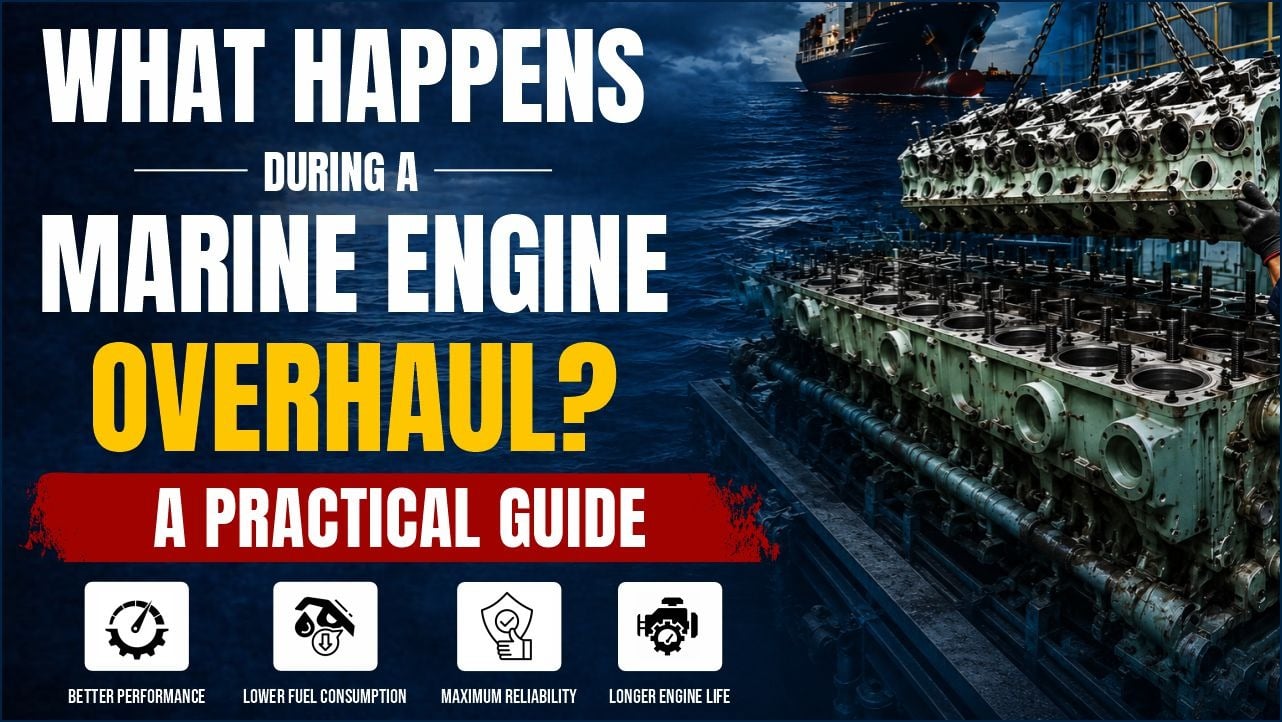
A major marine engine overhaul typically involves dismantling the engine to inspect, measure, recondition, or replace its core components. The scope of work is dictated by the engine's running hours (e.g., 8,000, 16,000, or 32,000-hour intervals) and condition-based monitoring data.
The process generally involves:
- Preparation and Immobilization: Securing the engine, draining cooling water and lubricating oil systems, and rigging lifting gear.
- Cylinder Head Removal: Disconnecting high-pressure fuel lines, exhaust manifolds, and cooling water connections. The massive cylinder covers are lifted to expose the combustion chamber.
- Piston Pulling and Inspection: The piston is extracted using the engine room crane. Engineers measure the piston rings for wear, inspect the piston crown for thermal cracking or burn marks, and clean the ring grooves.
- Cylinder Liner Calibration: The cylinder liner is gauged using an inside micrometer to measure wear patterns, ovality, and clover-leafing. If the wear exceeds OEM limits (typically 0.8% to 1% of the bore diameter), the liner must be replaced or re-honed.
- Bearing Inspection: Main bearings, crankpin bearings, and crosshead bearings are opened. The bearing shells are inspected for scoring, wiping, or cavitation. Clearances are measured using lead wire or plastigauge.
- Fuel System Reconditioning: Fuel injectors, fuel pumps, and delivery valves are overhauled, calibrated, and pressure-tested on a test bench to ensure correct atomization and opening pressures.
- Reassembly and Sea Trials: Components are reassembled strictly adhering to OEM torque specifications. The engine undergoes gradual running-in procedures and sea trials to verify performance parameters like exhaust temperatures, peak pressures, and vibration levels.
Real-World Observations: The Hidden Challenges
During vessel maintenance projects, technical teams frequently encounter situations where theoretical planning clashes with operational reality.
"One of the most common procurement mistakes happens months before the overhaul begins. A technical department orders a standard 'overhaul kit' for the piston, but fails to account for the actual wear rates of the cylinder liner based on recent scavenge port inspections. During a dry dock in Singapore, an engineering team pulled a piston only to discover the liner wear was severe enough to require an oversized piston ring set. Because these were not procured in advance, the vessel suffered a 4-day delay waiting for parts to be flown in, costing the owners thousands in daily dry-dock fees."
Technical superintendents know that an overhaul is only as smooth as the pre-planning. Discovering a deeply scored crankpin journal mid-overhaul transforms a routine maintenance task into a major machining operation requiring in-situ crankshaft grinding specialists.
Common Mistakes During Engine Overhauls
Procurement Mistakes
- Late Ordering: Ordering critical, long-lead-time items (like cylinder liners or fuel pump plungers) too close to the overhaul date, risking delays.
- Incomplete Spares Kits: Failing to order the necessary O-rings, gaskets, and locking washers, which often halt reassembly.
Inspection Mistakes
- Ignoring the Scavenge Space: Focusing only on the piston and liner while neglecting a thorough inspection and cleaning of the scavenge air receiver, leading to potential scavenge fires post-overhaul.
- Inaccurate Calibration: Taking liner measurements at incorrect temperature conditions, leading to false wear readings.
Storage Mistakes
- Contamination: Leaving sensitive bearing shells or fuel pump components exposed to the dirty engine room environment during the overhaul, allowing abrasive dust to settle on them.
- Improper Staging: Staging heavy components randomly around the engine room floor rather than in designated, secure laydown areas.
Installation Mistakes
- Incorrect Torque: Relying on 'feel' rather than calibrated hydraulic tensioning tools, resulting in unevenly tightened cylinder head studs.
- Skipping the Running-In Process: Pushing the engine to full load immediately after an overhaul without following the OEM's stepped running-in protocol, resulting in immediate ring scuffing.
Practical Checklist: Executing a Successful Overhaul
- Pre-Overhaul Assessment: Review recent engine performance logs, oil analysis reports, and scavenge port inspection photos to anticipate required spares.
- Inventory Verification: Physically verify that all required spare parts, gaskets, and specialized hydraulic tools are onboard and functioning before dismantling begins.
- Lockout/Tagout (LOTO): Ensure all starting air, fuel, and cooling systems are securely isolated and depressurized.
- Component Marking: Clearly mark the orientation and cylinder number of all removed parts (bearings, valves, pistons) to ensure they are returned to their exact original locations.
- Calibration Logging: Document all measurements (liner wear, bearing clearances, ring gaps) meticulously in the engine logbook for Class surveyors and future reference.
- Cleanliness Verification: Ensure all oil galleries, cooling water spaces, and the crankcase are completely free of rags, tools, and debris before final closure.
- Hydraulic Tensioning Check: Double-check the hydraulic pressure applied to all major studs against the OEM manual.
Real-World Marine Maintenance Example
On a container ship utilizing a MAN B&W 6S60MC engine, the crew initiated a scheduled 16,000-hour overhaul of unit number 4. During the extraction of the cylinder cover, the engineers noted unusual carbon buildup in the cooling water spaces. Instead of simply cleaning it and proceeding, the Chief Engineer investigated further and discovered a hairline crack in the cylinder cover cooling jacket. This crack had allowed minimal combustion gas to enter the cooling system. By identifying this early warning sign during the overhaul—and replacing the cover using a spare sourced securely—the team prevented a major thermal failure and potential loss of propulsion while crossing the Pacific.
FAQ Section
How long does a major marine engine overhaul take? Depending on the engine size, the scope of work, and the size of the engineering team, overhauling a single cylinder unit on a large two-stroke engine can take anywhere from 12 to 24 hours of continuous work. A complete engine overhaul typically occurs during a 10 to 14-day dry dock.
Why is measuring bearing clearance so critical? Bearing clearances dictate the thickness of the hydrodynamic oil film that separates the moving metal parts. Too much clearance causes a drop in oil pressure and knocking; too little clearance causes friction, overheating, and catastrophic bearing wipe.
What is 'running-in' an engine? Running-in is the process of operating the engine at gradually increasing loads over several hours after installing new cylinder liners or piston rings. This allows the newly machined metal surfaces to wear together smoothly and establish a proper seal.
How often should a marine engine be overhauled? Overhaul intervals are dictated by the engine manufacturer based on running hours. For example, fuel injectors might need an overhaul every 4,000 hours, while a major piston pulling and liner inspection might be scheduled every 16,000 to 32,000 hours.
How can ship owners reduce overhaul costs? Costs can be controlled through meticulous condition-based monitoring (using oil analysis and vibration monitoring to extend intervals safely) and by sourcing high-quality genuine or OEM-equivalent spare parts in advance, avoiding premium emergency shipping rates.
Conclusion
A marine engine overhaul is an uncompromising test of a vessel's technical management. Success relies heavily on accurate pre-planning, rigorous adherence to OEM procedures, and the absolute cleanliness of the reassembly process. When ship owners provide their engineering teams with the correct tools, sufficient time, and verified genuine spare parts, the engine will consistently deliver reliable propulsion.
For operators looking to secure critical components for upcoming dry docks, partnering with experienced suppliers like UTS Marine LLP ensures that your major overhauls proceed without the crippling delays caused by missing or sub-standard spares.
Internal Linking Suggestions
- [Link: 7 Critical Checks Before Buying Used Marine Engine Spare Parts from Alang Ship Breaking Yard]
- [Link: New vs Reconditioned Marine Engine Parts: How to Choose the Right Option for Your Vessel]
- [Link: MAN B&W vs Sulzer Two-Stroke Marine Engines: Spare Parts Comparison for Ship Owners]
Standard Overhaul Checklist
A comprehensive overhaul is a meticulous process. Below is the standard checklist used by chief engineers:
- Cylinder Head: Remove, decarbonize, pressure test cooling spaces, lap valve seats. (See our MAN B&W L32/40 Cylinder Head for replacement options).
- Piston & Rings: Extract piston, clean ring grooves, measure axial clearance, replace rings.
- Cylinder Liner: Calibrate bore wear using inside micrometers, hone surface to restore cross-hatch.
- Main Bearings: Inspect bearing shells for cavitation and tin-flash wear, measure crankshaft deflection.
- Fuel Injection: Overhaul injectors, pop-test for opening pressure and atomization.
Frequently Asked Questions
How often is a major marine engine overhaul required?For most large 2-stroke crosshead engines, a major overhaul is typically scheduled every 24,000 to 36,000 running hours, aligning with the vessel's 5-year special survey. However, 4-stroke auxiliary engines may require top-end overhauls every 12,000 hours.
Can I reuse crosshead bearing shells?While possible if wear limits are strict, class surveyors generally recommend replacing them during a major overhaul to guarantee another 5 years of safe operation without catastrophic failure.