Introduction
Observing marine engine exhaust smoke is one of the most reliable and immediate ways to identify underlying mechanical faults. Different colours indicate entirely different combustion issues. Ignoring these early warning signs often leads to severe component failure, increased fuel consumption, and non-compliance with maritime emission regulations.
Understanding Exhaust Smoke Colours
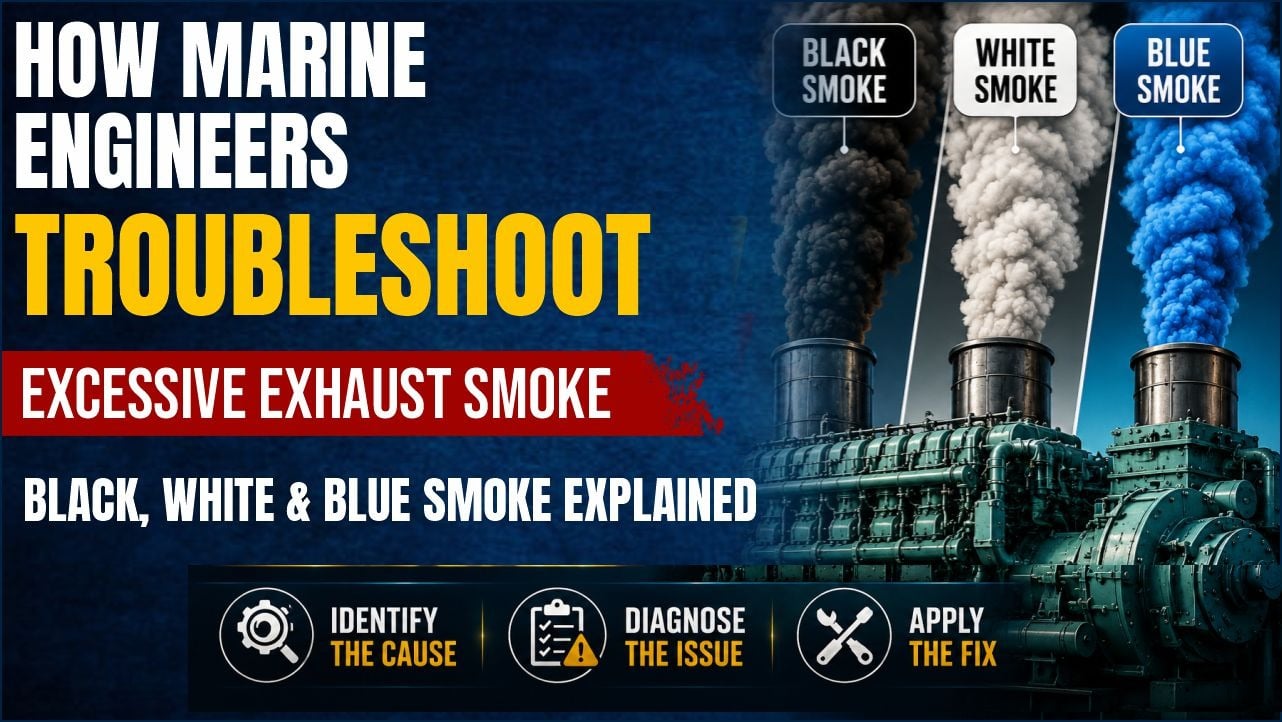
A healthy marine diesel engine under normal load should produce virtually invisible exhaust gas. When combustion efficiency drops or mechanical integrity fails, the exhaust stack acts as a visual diagnostic tool. The three primary colours indicating faults are black, white, and blue.
Common Causes of Black Smoke
Black smoke from a marine diesel engine indicates incomplete combustion. The engine is either receiving too much fuel or insufficient air to burn the fuel charge completely.
- Faulty injectors: Worn nozzle holes, carbon buildup, or weak injector springs lead to poor atomization. Fuel enters the cylinder in droplets rather than a fine mist, burning incompletely and forming soot.
- Incorrect fuel timing: Retarded injection timing means the fuel ignites too late in the power stroke. It does not have enough time to burn completely before the exhaust valve opens.
- Restricted air supply: Clogged scavenge air filters or fouled air coolers restrict the oxygen required for complete combustion.
- Turbocharger issues: A fouled turbocharger compressor side, damaged turbine blades, or worn bearings will fail to deliver the required scavenge air pressure.
Common Causes of White Smoke
White smoke marine engine faults usually point to unburnt fuel particles or steam passing through the exhaust system.
- Water ingress: A cracked cylinder head, a leaking cylinder liner O-ring, or a damaged head gasket allows cooling water to enter the combustion space, flashing into steam.
- Low compression: Worn piston rings, scored cylinder liners, or leaking exhaust valves prevent the cylinder from reaching the auto-ignition temperature required to burn the fuel charge.
- Poor fuel atomization: Similar to black smoke causes, but occurring primarily during cold starts when cylinder temperatures are already low.
Common Causes of Blue Smoke
Blue smoke diesel engine conditions are a direct result of lubricating oil entering the combustion chamber and burning alongside the fuel.
- Oil entering combustion chamber: Often caused by excessive oil pressure or high crankcase pressure forcing oil past seals.
- Worn piston rings: Oil scraper rings that are worn, stuck in their grooves due to carbon, or broken fail to scrape lubricating oil off the liner wall.
- Cylinder liner wear: Glazed or oval-worn cylinder liners prevent the piston rings from sealing correctly, allowing oil to bypass into the combustion space.
Step-by-Step Troubleshooting Process
Diagnostic Checklist
- Check cylinder exhaust temperatures for deviations.
- Inspect scavenge air pressure and temperature.
- Analyze fuel injection timing and pump rack positions.
- Perform a crankcase inspection for signs of blow-by.
- Test cooling water for traces of combustion gases.
Troubleshooting Table
Smoke Colour Primary Indicator Immediate Action Black Incomplete combustion (Fuel/Air imbalance) Check turbocharger RPM, clean air filters, test fuel injectors. White Steam (Water ingress) or unburnt cold fuel Test cooling water pressure, check jacket water header tank levels. Blue Burning lubricating oil Check sump oil consumption rates, inspect piston rings via scavenge ports.FAQ
Why does my marine engine blow black smoke under heavy load?
Heavy loads demand more fuel. If the turbocharger cannot supply a corresponding increase in scavenge air (due to fouling or wear), the fuel-to-air ratio becomes excessively rich, resulting in unburnt carbon (black smoke).
Can bad fuel cause white smoke?
Yes. Fuel contaminated with water will atomize poorly and turn to steam during the combustion process, appearing as white smoke at the funnel.