Excessive engine vibration represents one of the most destructive forces in a ship's engine room. Left unchecked, abnormal vibrational frequencies lead to metal fatigue, cracked foundation welds, shattered pipe connections, and catastrophic bearing failure. Marine engine vibration analysis allows technical teams to identify the exact mechanical or hydrodynamic fault causing the disturbance without dismantling the machinery.
Common Causes of Excessive Engine Vibration
Vibration diagnosis in a marine engine requires isolating the frequency and amplitude of the movement to match it with known mechanical faults.
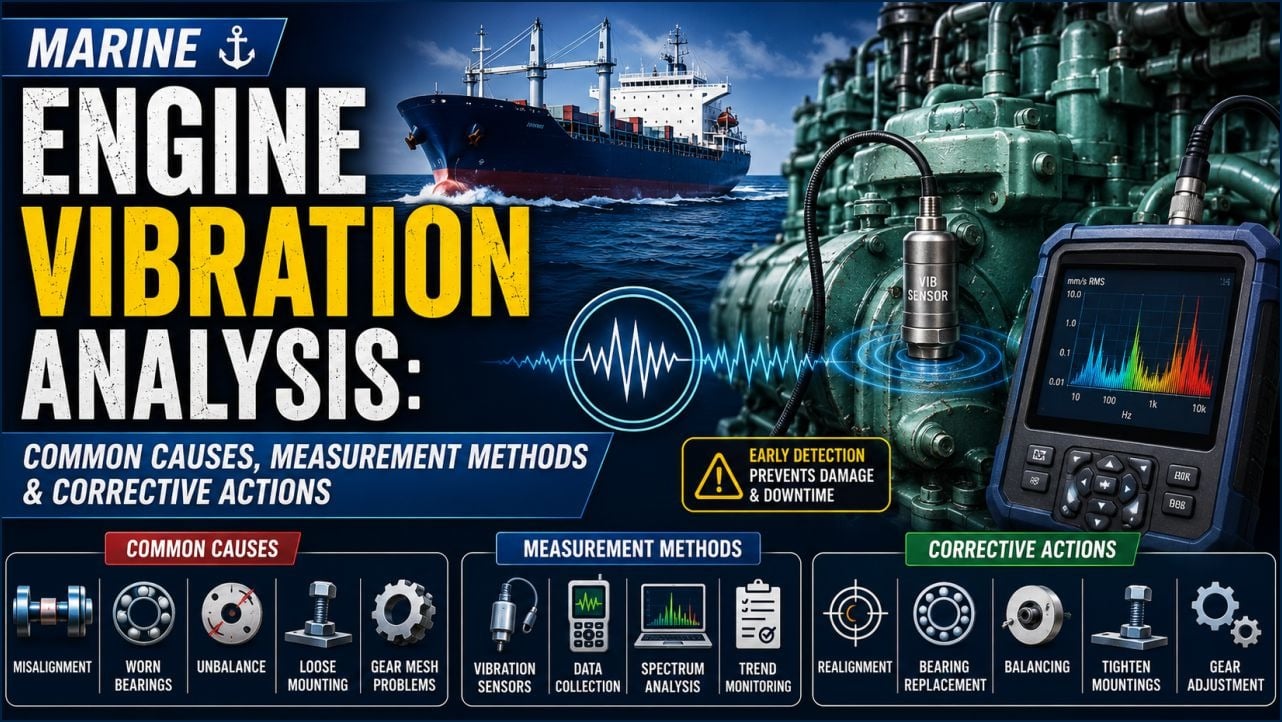
- Crankshaft Imbalance: Uneven weight distribution across the rotating mass, often caused by uneven combustion pressures between cylinders, damaged counterweights, or variations in piston assembly weights following an overhaul.
- Engine Misalignment: Occurs when the centerline of the engine crankshaft no longer perfectly matches the centerline of the intermediate shaft or alternator. Engine alignment vibration generates severe radial loads, rapidly destroying main bearings and flexible couplings.
- Loose Foundation Bolts: Engine holding-down bolts stretch or loosen over time due to hull deflection and thermal expansion. This allows the entire engine block to shift laterally during operation.
- Bearing Wear: Excessive clearance in main bearings or thrust bearings allows the crankshaft to physically move outside its designed hydrodynamic axis, generating distinct knocking frequencies.
- Propeller or Hull Excitation: Damaged propeller blades, marine growth, or operation in shallow water transmits hydrodynamic vibrations directly up the shaft line into the engine structure.
Vibration Measurement Methods
Engineers measure vibration using piezoelectric accelerometers temporarily attached to specific points on the engine block, bearing housings, and turbocharger casings. The data collector converts the physical motion into a spectrum graph showing amplitude (severity) plotted against frequency (cycles per minute).
By analyzing the frequency peaks, specialists can pinpoint the defect. For example, a high amplitude spike exactly at the engine's running speed (1X RPM) typically indicates an imbalance, while a spike at twice the running speed (2X RPM) heavily points toward misalignment.
Vibration Troubleshooting Table
Symptom / Frequency Characteristic Probable Cause Required Corrective Action High vibration at exactly 1X engine RPM Mass imbalance (Combustion or Mechanical) Take engine indicator cards to balance cylinder peak pressures. Check counterweights. High vibration at 2X engine RPM, high axial vibration Misalignment across the coupling Check shaft alignment using dial indicators or laser alignment tools. Adjust chocks. Multiple harmonic peaks (1X, 2X, 3X, 4X RPM) Mechanical looseness Tighten engine holding-down bolts, check tie rod tension, inspect foundation welds. High-frequency non-harmonic noise Bearing damage / insufficient lubrication Take oil sample. Perform crankcase inspection and check bearing clearances.Corrective Actions and Engine Alignment
Fixing engine alignment vibration requires checking the crankshaft web deflections using a dial indicator. Deflection readings outside the manufacturer's tolerances confirm that the engine block has warped or the shaftline has settled. Engineers correct this by replacing the resin chocks under the engine base, adjusting the foundation bolts, and realigning the prime mover to the driven equipment.
Routine vibration analysis serves as a cornerstone of predictive maintenance, turning invisible mechanical stresses into measurable data before parts fracture.