Marine sea water pumps act as the heart of a vessel's central cooling system. Operating constantly in a highly corrosive environment, these centrifugal pumps draw raw seawater through the sea chests and push it through the central coolers. Failure of a marine cooling pump immediately jeopardizes the main engine and auxiliary generators due to rapidly rising jacket water temperatures. Strict adherence to marine sea water pump maintenance prevents unexpected breakdowns.
Primary Wear Points in Seawater Pumps
Because seawater contains salt, sand, and marine life, pump components suffer from simultaneous chemical corrosion and mechanical erosion.
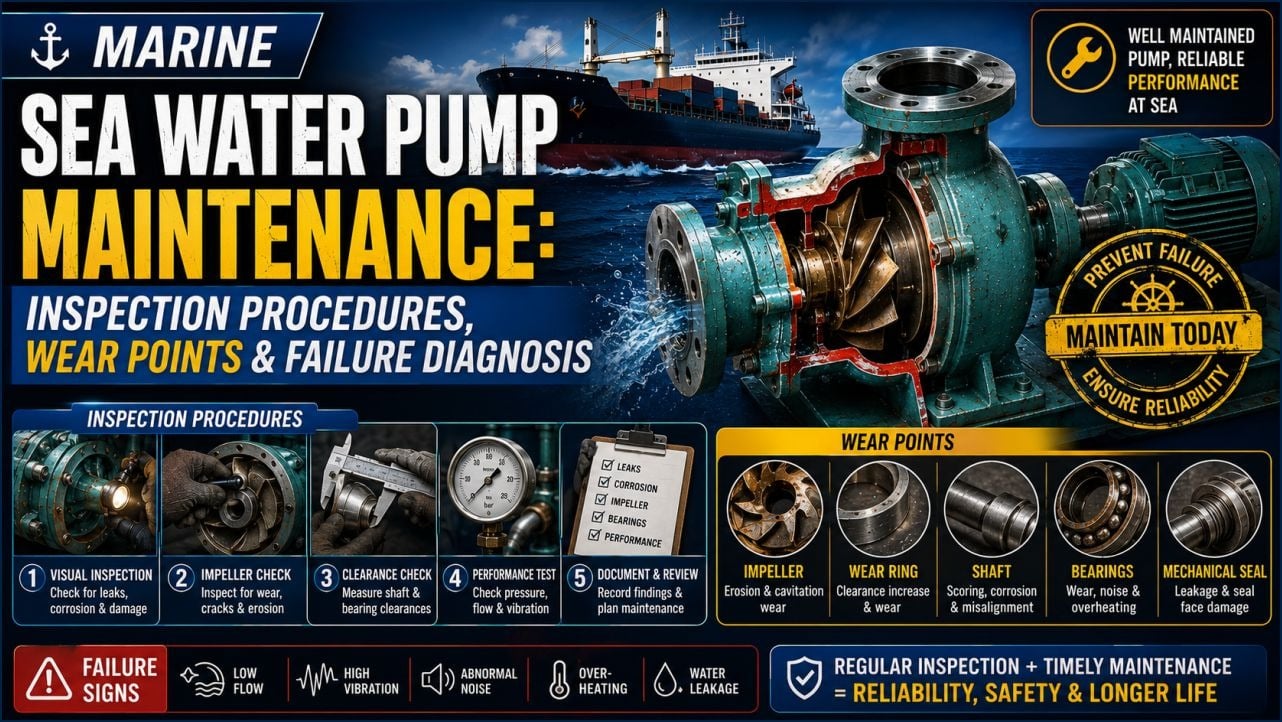
- Impeller Wear: The bronze or stainless-steel impeller accelerates the water radially. Sand and silt continuously erode the impeller vanes, reducing the pump's volumetric efficiency. A worn impeller fails to generate the necessary discharge pressure, leading to cooling system alarms.
- Mechanical Seals: Located where the rotating shaft enters the pump casing, mechanical seals prevent seawater from leaking outward. They consist of a rotating face and a stationary face pressed together by a spring. Abrasive particles in the seawater scratch these highly polished faces, causing external leakage.
- Shaft Sleeves: A protective sleeve covers the main pump shaft in the area passing through the mechanical seal or stuffing box. Over time, friction scores the sleeve. If the sleeve becomes deeply grooved, a new seal will fail to seat properly and will immediately leak.
- Bearings: Ball or roller bearings support the pump shaft. Water ingress from a failed mechanical seal washes away the bearing grease, leading to rapid rusting, excessive vibration, and eventual seizure of the bearing assembly.
Corrosion and Cavitation Diagnosis
Beyond mechanical wear, engineers inspecting a marine cooling pump overhaul must differentiate between corrosion and cavitation damage on the impeller and casing.
Galvanic Corrosion: Seawater acts as an electrolyte. When dissimilar metals (e.g., a bronze impeller and a cast-iron casing) touch, the less noble metal corrodes. Sacrificial zinc anodes installed inside the pump casing prevent this. During inspection, if the zinc anodes have completely dissolved, the pump casing is actively deteriorating.
Cavitation: Occurs when the suction pressure drops below the water's vapor pressure, typically caused by a blocked sea suction strainer or running two pumps in parallel incorrectly. Vapor bubbles form and collapse violently against the impeller. Cavitation damage appears as deep, pitted, sponge-like craters on the trailing edges of the impeller vanes, distinct from the smooth grooves of sand erosion.
Seawater Pump Inspection and Overhaul Procedure
Executing a standard marine pump overhaul involves systematic measurement and replacement of wear components.
- Isolation and Draining: Secure the electrical breaker, shut the suction and discharge valves, and open the casing drain plug to remove trapped seawater.
- Clearance Measurement: Before removing the impeller, use a feeler gauge to measure the clearance between the impeller wearing ring and the casing wearing ring. Excessive clearance allows high-pressure water to recirculate back to the suction side, drastically dropping the pump's output pressure.
- Dismantling: Remove the pump casing, impeller nut, and impeller. Extract the mechanical seal assembly and inspect the shaft sleeve for scoring.
- Bearing Replacement: If the shaft shows radial play, dismantle the bearing housing. Always replace bearings and mechanical seals as a complete set during a scheduled overhaul.
- Assembly and Testing: Reassemble the components, ensuring the mechanical seal faces are spotlessly clean and lubricated according to the manual. Rotate the shaft by hand to confirm free movement before restoring power.
Routine seawater pump inspection ensures the vessel maintains its primary cooling capacity, avoiding dangerous main engine slowdowns during maneuvering.