Understanding the System
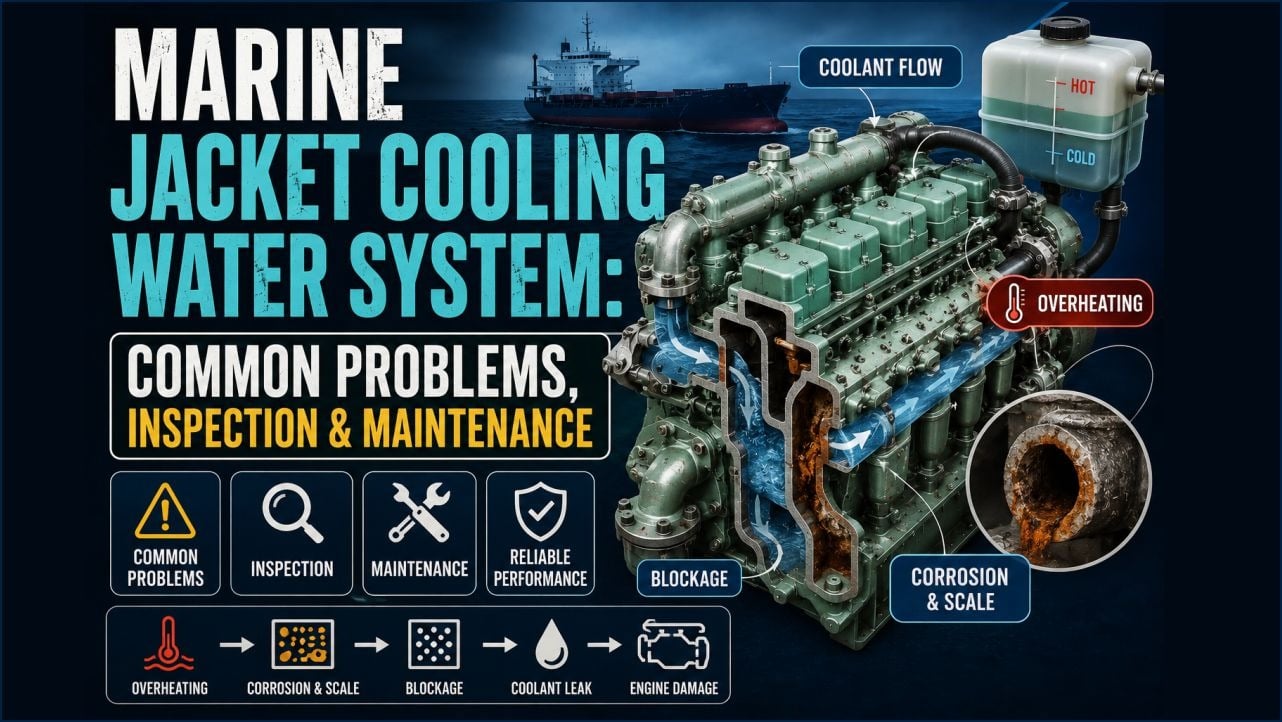
The jacket cooling water system is a closed-loop circuit vital for maintaining the thermal balance of a marine diesel engine. It circulates treated fresh water through the cylinder jackets, cylinder heads, and sometimes the turbocharger casings. By removing excess heat generated during combustion, it prevents thermal stress, preserves lubricating oil properties, and keeps clearances within safe limits. Understanding its flow path—from the engine spaces to the heat exchangers (coolers) and back—is the foundation of good troubleshooting.
The Flow Path
Water is drawn from the expansion tank by the jacket water circulating pumps and pushed through the engine block. It flows upwards around the cylinder liners, through the cylinder heads, and exits to a common manifold. A thermostatic valve then directs the hot water either to the central coolers (to be cooled by seawater or central fresh water) or bypasses the cooler directly back to the pump suction, maintaining a constant temperature usually around 80°C to 85°C.
Common Failures and Warning Signs
Issues in this system often manifest as temperature alarms or loss of water pressure. Sudden temperature spikes can indicate an air lock, a failed pump, or a stuck thermostatic valve. A gradual increase in running temperatures usually points towards fouling in the heat exchanger or scale buildup within the engine cooling spaces.
The Threat of Scale Formation
Even with distilled water, scale can form if water treatment is neglected. Scale acts as an insulator, drastically reducing heat transfer. This leads to localized overheating (hot spots) in the cylinder liners and heads, which can cause thermal cracking. Regular testing of jacket water (checking nitrites, chlorides, and pH levels) and dosing with the correct chemical inhibitors is non-negotiable to prevent both scale and corrosion.
Pump Problems
Centrifugal pumps used for jacket water circulation are generally robust but not immune to failure. Mechanical seal leaks are the most common issue. Engineers must regularly check the tell-tale drain for leakage. Additionally, listen for cavitation (sounding like gravel in the pump casing), which can occur if the expansion tank level drops too low, leading to poor suction head and air ingress.
Temperature Monitoring
Relying solely on the main engine alarm system isn't enough. Routine rounds should involve physically checking local thermometers at individual cylinder head outlets. A significant temperature deviation (high or low) on a single unit can indicate a blocked cooling passage or a problem with combustion on that specific cylinder.
Maintenance Schedule
- Daily: Check expansion tank level, pump discharge pressure, and individual unit temperatures. Look for leaks around seals and joints.
- Weekly: Test water chemistry and dose chemicals as required.
- Monthly: Test the high-temperature alarms and thermostatic valve operation.
- Yearly/Dry Dock: Open heat exchangers for cleaning. Overhaul circulating pumps (replace bearings and mechanical seals). Inspect cylinder cooling spaces during piston overhauls.
Troubleshooting Guide
Symptom Possible Cause Action Required High jacket water temperature (overall) Fouled cooler, stuck thermostatic valve, low water level Clean cooler, inspect/replace thermostatic element, top up tank and vent system High temperature on a single cylinder Restricted flow to that unit, poor combustion Check valves/orifices, investigate fuel injection/combustion Loss of water from expansion tank Leak in the system, cracked cylinder liner/head Trace the leak; check scavenge spaces or crankcase for water ingressFrequently Asked Questions
Why do we keep the jacket water warm when the engine is stopped?
Pre-heating the jacket water prevents thermal shock when starting the engine and keeps the cylinder liners warm, preventing condensation of sulfuric acid from combustion gases.
What causes air locks in the cooling system?
Air locks usually happen after maintenance if the system isn't vented properly while filling, or if combustion gases blow into the cooling spaces through a cracked liner or head.