The Core Question in Marine Procurement
Every ship manager and fleet superintendent faces this decision during every planned overhaul: should I order new OEM parts or use reconditioned ones? The wrong choice in either direction has real consequences — unnecessary cost from buying new when reconditioned is perfectly safe, or vessel downtime and safety incidents from using substandard reconditioned parts without proper inspection.
This guide provides a structured, practical framework from the marine engineering experts at UTS Marine LLP — a company that has supplied both new and rigorously inspected reconditioned parts to ship owners and managers in 50+ countries for over 10 years.
Understanding the Four Categories of Marine Spare Parts
Marine spare parts fall into four distinct categories, each with different reconditioning considerations:
1. Consumable Safety-Critical Parts — Always Buy New
These parts have defined service lives, are inexpensive relative to the consequences of failure, and cannot be reliably restored. They must always be replaced new:
- Piston rings — surface finish and ring tension cannot be restored
- Fuel injector nozzles — spray pattern precision is irreversible once worn
- O-rings, seals, and gaskets — elastomeric materials age and cannot be restored
- Exhaust valve springs — spring fatigue is invisible and failure is catastrophic
- Liner O-ring grooves inserts — dimensional tolerance too tight for reconditioning
2. Structural/Mechanical Components — Safe to Recondition with NDT
These large, expensive components can be safely reused when properly inspected and dimensionally verified:
- Cylinder liners — honed and measured; MPI and UT detectable defects
- Piston crowns and skirts — crack-detectable; dimensional check confirms fitness
- Cylinder heads — hydraulic pressure tested and MPI inspected
- Crankshafts — MPI detectable cracks; journal diameters measurable
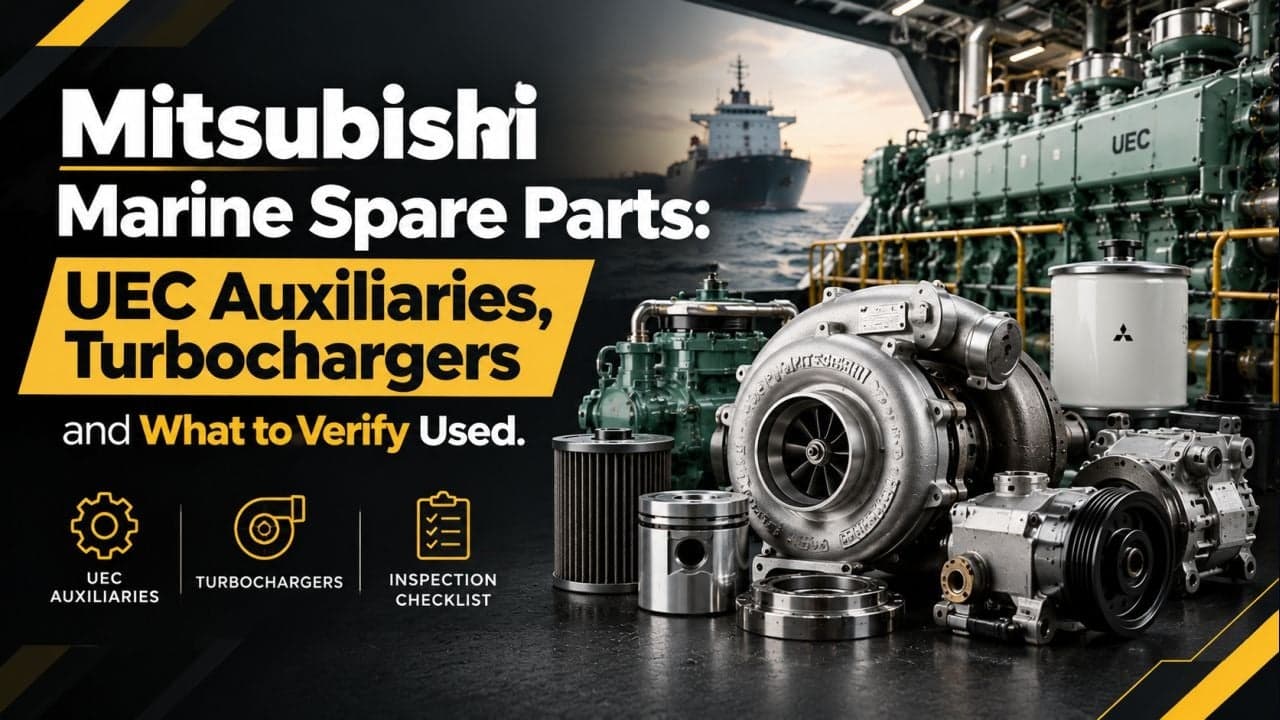
- Turbocharger rotors and housings — NDT testable; balance verifiable
- Fuel pump barrels and plungers — clearance measurable by leak-off test
3. Machinery Units — Case-by-Case Evaluation
Complete machinery units (oil purifiers, air compressors, hydraulic pumps) can often be safely supplied used, provided they undergo operational testing and full component inspection. The economics are particularly compelling — a complete used Alfa Laval oil purifier can cost 60-70% less than a new equivalent.
4. Complete Engines — Specialist Assessment Required
Used main and auxiliary engines require comprehensive evaluation: pressure testing of all cooling water passages, MPI of the crankshaft and main bearings, measurement of all cylinder bores, and operational test if possible. When properly assessed, they represent extraordinary value — particularly for power plants and vessels facing end-of-life engine replacement.
The Critical Role of NDT Testing
The single most important factor that determines whether a reconditioned marine part is safe is the quality of its Non-Destructive Testing (NDT). NDT inspects a part's internal and external integrity without damaging it.
For reconditioned marine parts, the essential NDT tests are:
- Magnetic Particle Inspection (MPI): Detects surface and near-surface cracks in ferromagnetic materials. Used for crankshafts, cylinder heads, connecting rods, exhaust valve spindles, and piston crowns.
- Ultrasonic Testing (UT): Detects internal flaws and measures wall thickness. Used for cylinder liners, pressure vessels, and structural components.
- Hydraulic Pressure Testing: Confirms that cylinder heads, valve cages, cooling jackets, and heat exchangers hold pressure at operating conditions.
- Hardness Testing: Verifies that case-hardening or surface treatment is intact and material properties meet specification.
- Dimensional Measurement: Confirms all critical dimensions are within OEM tolerance — bore diameters, journal diameters, valve seat face angles, clearances.
At UTS Marine LLP, all reconditioned parts undergo the applicable tests from the above list, conducted by qualified Level II and Level III NDT Engineers according to ASTM, ISO, and Classification Society standards. Full test certificates are issued with every part.
Classification Society Acceptance
Classification societies — DNV, Lloyd's Register, ABS, Bureau Veritas, ClassNK — assess parts for fitness for service, not for newness. A reconditioned part accompanied by valid NDT test certificates, dimensional measurement records, and hydraulic pressure test certification is accepted by all major classification societies.
UTS Marine LLP provides complete documentation packages as standard, including material certificates (EN 10204 3.1 or 3.2) where required, and can arrange IACS member classification society witness inspection for high-value components upon request.
Cost Analysis: The Real Numbers
The cost differential between new OEM and properly inspected reconditioned parts is substantial — and the savings compound across an entire overhaul program:
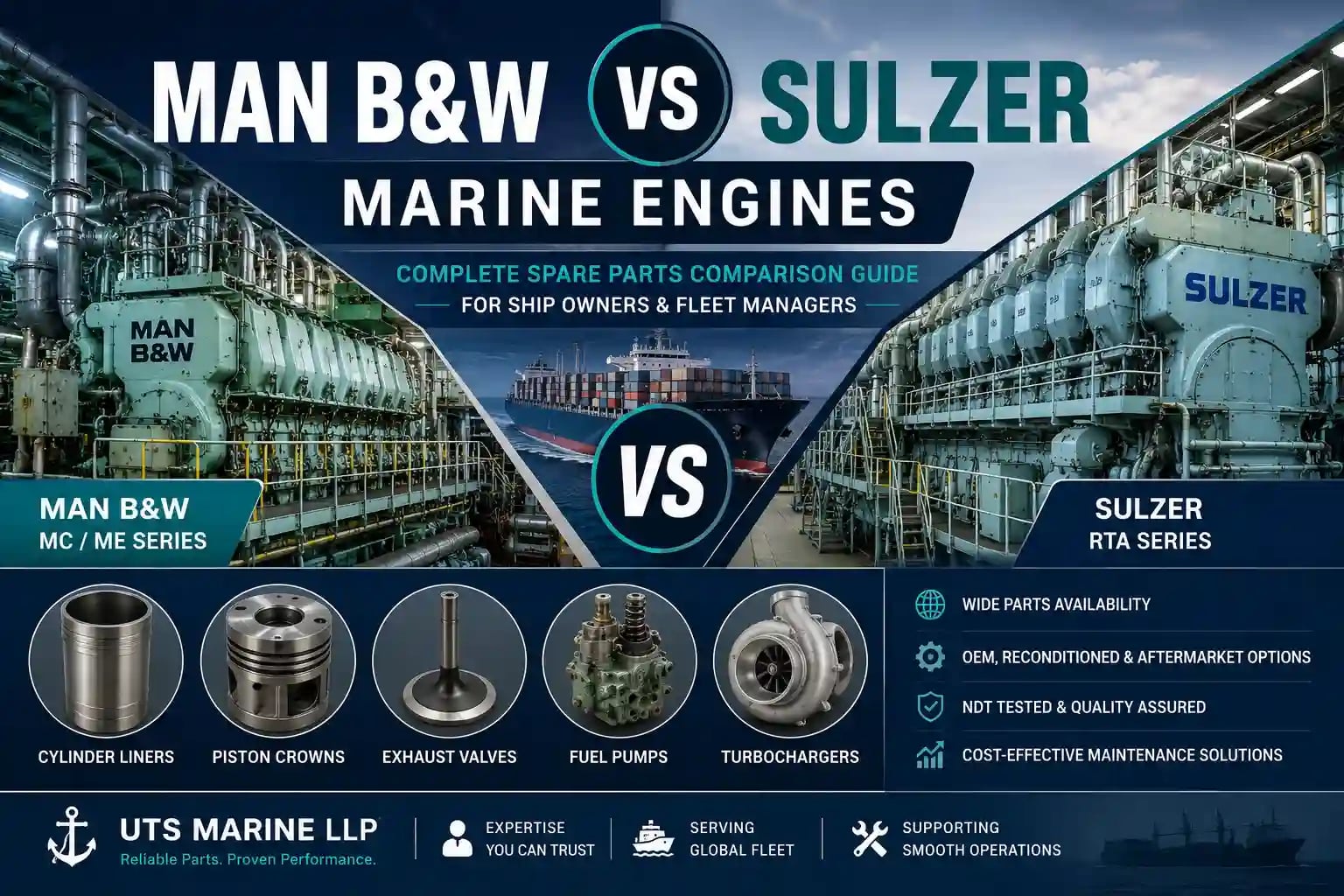
- MAN B&W K98MC cylinder liner: New OEM ~$15,000–20,000 | Reconditioned (NDT tested) ~$6,000–8,000
- Sulzer RTA96C piston crown: New OEM ~$12,000–18,000 | Reconditioned ~$5,000–7,000
- ABB VTR 454-32 turbocharger rotor: New ~$25,000+ | Reconditioned ~$8,000–12,000
- Alfa Laval MMPX 304 oil purifier bowl: New ~$8,000 | Reconditioned (pressure tested) ~$2,500–3,500
For a typical two-stroke engine overhaul, the savings from using properly inspected reconditioned components for the large structural parts — while buying new for all consumables — can reach $50,000–150,000 per engine per overhaul cycle.
Making the Right Decision: A Practical Framework
When evaluating any marine spare part for reconditioning, ask these questions:
- Is it a consumable with a defined service life? → Always new.
- Can its integrity be confirmed by NDT? → Likely safe to recondition if NDT passes.
- Are the critical dimensions verifiable against OEM spec? → Dimensionally verifiable = reconditionable.
- What is the consequence of failure? → Higher consequence = stricter NDT requirements, not necessarily new parts.
- Is the supplier providing test certificates with Level II/III engineer signatures? → No certificates = do not accept.
UTS Marine LLP is available to assess any specific part requirement and provide honest, expert advice on whether new or reconditioned is the right choice for your situation.
Contact UTS Marine LLP
With over 10 years of experience supplying marine spare parts from Alang to ship owners, managers, and repairers worldwide, our team has the expertise to source the right part at the right quality and price.
Phone: +91-9723298676
Emergency: +91-9558424949 (24/7)
Email: sales@utsmarinellp.com